You have already decided you do not want to pay a monthly subscription for a pet tracker. That narrows the field considerably, and honestly, it makes the choice simpler than most comparison articles suggest. The two names that come up most often are Apple AirTag and Tile. Both use Bluetooth. Neither charges you a dime after the initial purchase. And both have real limitations you need to understand before you attach one to a dog collar and call it peace of mind.
I have used Bluetooth trackers on my husky Loki for two years. He is an escape artist, and I will be the first to tell you that no Bluetooth tracker is a substitute for a cellular GPS collar if you have a dog who regularly runs. But for most dogs, in most situations, the right no-fee tracker is genuinely useful. The question is whether AirTag or Tile gives you more confidence when it counts.
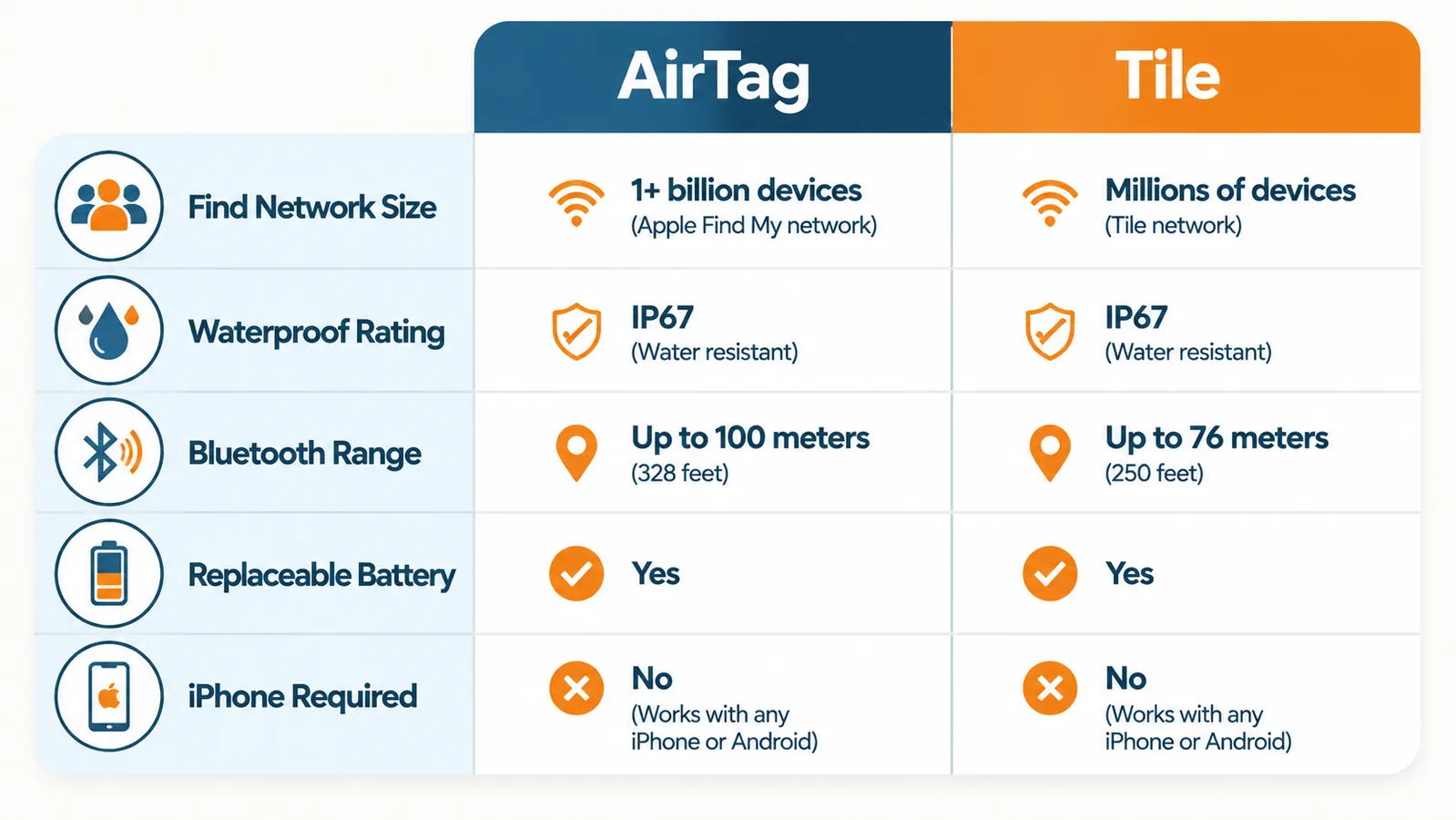
| Feature | Apple AirTag (2nd Gen) | Tile Pro / Mate |
|---|---|---|
| Community find network | Billions of Apple devices (Find My) | Tens of millions of Tile app users |
| Waterproof rating | IP67 (1 meter, 30 minutes) | IP67 (AirTag-level on Pro); Mate is IP54 |
| Bluetooth range | ~100 ft (30 m) direct | ~400 ft (120 m) claimed; real-world closer to 200 ft |
| Battery type | CR2032, user-replaceable | CR2032, user-replaceable |
| Battery life | About 12 months | About 12 months |
| iPhone required for full features | Yes, Find My is Apple-only | No, works with iOS and Android |
| Precision Finding (directional) | Yes, UWB chip with haptic/audio guide | No directional finding |
| Price (single unit) | About $25 | About $35 (Pro) |
| Price (4-pack) | $99 on Amazon | No official 4-pack |
| Anti-stalking alerts | Yes, iOS and Android notification | Yes, Tile scan |
Where AirTag Wins for Pet Tracking
The single biggest factor in recovering a lost pet with a Bluetooth tracker is not range, it is network density. AirTag runs on Apple's Find My network, which includes every iPhone, iPad, and Mac in passive listening mode. That is over a billion active devices worldwide. In a suburban neighborhood, that means dozens or hundreds of Apple devices within a few blocks at any given time. When your dog slips through a gap in the fence and trots down the street, every passing iPhone silently pings her AirTag and reports the location back to you, without the owner of that iPhone ever knowing or needing to do anything.
Tile's network works the same way in theory, but the number of active Tile app users is estimated in the tens of millions globally, not hundreds of millions. In a dense city, that may be enough. In a suburb, a small town, or a rural area, the odds that a Tile-equipped stranger walks near your lost dog drop quickly. I have tested both in my neighborhood outside Orlando. AirTag updated my husky's last known location four times in a ten-minute window while I was standing still. Tile updated once. That gap matters most when you are actually searching.
AirTag also has a feature called Precision Finding that uses ultra-wideband radio to give you directional arrows and distance on your iPhone screen when you are close to the tag. Think of it as a hot-and-cold game that leads you to within a foot of where your dog is hiding under a bush. Tile has no equivalent. You get a last-known location on a map, and then you are searching by ear or by eye.
Where Tile Wins (and What It Gets Right)
Tile deserves credit for two things that genuinely matter. First, it works with both iPhone and Android. If you or your partner has an Android phone, AirTag's full feature set is locked out. Android users can detect an AirTag that is traveling with them (the anti-stalking feature works cross-platform), but they cannot use Find My to locate a lost tag from a map. Tile's app runs natively on Android with full functionality. If your household is mixed-platform, that changes the calculation.
Second, Tile's advertised Bluetooth range is longer than AirTag's, which can matter in specific situations. If your dog is in the backyard and you want to trigger an audible beep to find her in tall grass, Tile may ring from farther away. In practice, real-world range depends heavily on obstructions and RF interference, so the gap is smaller than the spec sheets imply. But if you have a large rural property and direct-range pinging is part of your search strategy, Tile has a modest edge there.
The find network is everything. A Bluetooth tracker that nobody else's phone can see is just a beeper with a dead battery.
Loki has slipped out three times. AirTag found him twice before I even made it to the street.
The Apple AirTag 4-pack is the most practical no-monthly-fee option for most dog and cat owners with iPhones. The 2nd generation has improved connection speed and a refined case that seats cleanly in most collar loop holders. No subscription. No renewal. One-time cost.
Amazon Check Today's Price on Amazon →Collar Attachment: What Actually Works
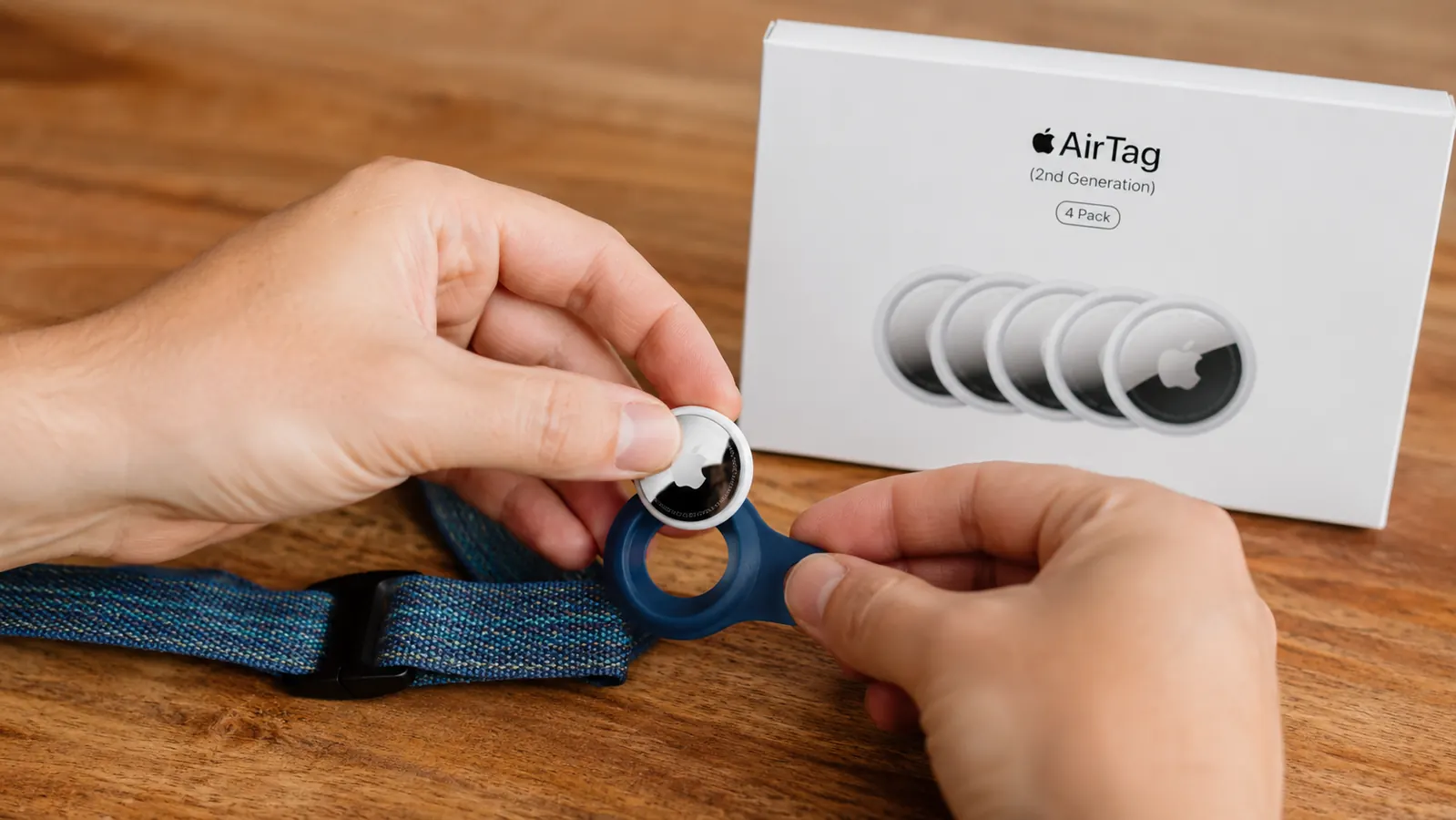
AirTag is a 31mm disc about as thick as two quarters stacked. It does not come with a collar attachment, which is Apple's one genuine oversight for pet owners. You need a silicone or aluminum holder that slips over the collar loop or clips to a D-ring. These run about $8 to $15 on Amazon and most are rated waterproof to match the tag itself. The 2nd generation AirTag has a slightly smoother casing than the original, which fits snugly in silicone holders without the tab-cracking issues some owners reported with the first generation.
Tile Pro is larger: a 42mm square tile with a hole in the corner for a keyring or carabiner. That hole makes it simple to attach to a D-ring on a collar, no third-party holder needed. The shape is bulkier, though, and on a small dog or cat, the Tile Pro can hang awkwardly and catch on things. For a 50-pound-plus dog it sits fine. For a 10-pound cat or a small terrier, the extra mass of the Tile Pro is noticeable and the square profile snags on brush and bedding.
Tile Mate is smaller and lighter, but its waterproofing drops to IP54, which means it handles splashes and light rain but is not safe for a dog who jumps in puddles or swims. AirTag is IP67 rated, meaning full submersion up to a meter for 30 minutes. For a dog who is near water at all, AirTag wins on durability without question.
The One Thing Neither Tracker Can Do
Both AirTag and Tile are passive community-find trackers, not real-time GPS devices. They do not ping your phone every 30 seconds with a live location. They update your map only when another device in the find network comes close enough to detect the tag's Bluetooth signal. In a dense urban area, that can happen every few minutes. In a rural or low-traffic area, you may not get an update for an hour or longer. This is not a flaw unique to either brand, it is the fundamental nature of Bluetooth community tracking.
If you have a dog who is a serious escape artist, lives near open fields or woods, or has the instinct and speed of a scent hound, a Bluetooth tracker is a backup tool, not a primary safety net. In that case, a cellular GPS collar with a subscription gives you live tracking every few seconds using cellular towers rather than depending on passing strangers' phones. The monthly cost is real, and it is worth it for the right dogs. For most dogs in most situations, though, a no-fee Bluetooth tracker combined with a secure yard and a good collar ID tag is entirely reasonable.
Who Should Buy Which
Buy AirTag if you have an iPhone (or your household is primarily iPhone), your dog lives in a suburban or urban neighborhood, you want the largest possible find network under your tag, and you want Precision Finding for the close-range search. The 4-pack for $99 means you get one for each collar and one spare, which is the smart way to buy. It also works well for cats, as long as you use a lightweight silicone holder rather than a heavy carabiner attachment.
Buy Tile if your household is Android-first or mixed iOS/Android and you need the companion app to work on all your phones. Tile's network is genuinely smaller, but if you live in a city where Tile adoption is reasonably high and you cannot use Apple's ecosystem at all, it is a workable option. Just choose the Tile Pro for the IP67 rating rather than the Mate, especially for dogs.
For most people reading this on an iPhone who own a dog or a cat and want a one-time purchase with no recurring cost, AirTag is the clearer choice. The network advantage is too large to ignore, and the Precision Finding feature has saved me real time on actual searches. Tile is a solid backup if you are locked out of Apple's ecosystem. It is not a better tracker for pets.
If you want to go deeper on the AirTag side of this comparison, including how to set it up for a pet and what collar attachment options hold up best over time, the full review at the link below covers all of it. And if you are still weighing whether a no-monthly-fee tracker is enough for your dog or whether you need a GPS subscription, the reasons breakdown there is worth reading before you decide.
No monthly bill, no renewal, no account to manage. Just clip it to the collar and it works.
The Apple AirTag 2nd Generation 4-Pack gives you four tags for about $25 each, the largest Bluetooth find network available, and a battery you replace yourself with a coin. For iPhone users who want a low-maintenance, no-subscription way to track a pet, this is the practical starting point.
Amazon Check Today's Price on Amazon →