
My rescue mutt Pepper bolted through a loose gate last spring. She is fast, she is small, and she blends into every suburban yard from three houses away. I had no GPS pinging me her location, no subscription app, nothing. I found her four blocks away by luck. That afternoon I ordered the Apple AirTag 4-pack and put one on her collar. Eight months later, I want to tell you exactly what this thing can and cannot do, because the honest answer is more useful than most reviews will give you.
The Apple AirTag is a Bluetooth community-find tracker, not a real-time GPS device. That one sentence contains everything you need to set the right expectations before you spend a dollar. The AirTag works by connecting to nearby Apple devices on the Find My network and reporting its location back to you through that crowdsourced web of iPhones and iPads. When Pepper is in range of any Apple device in the neighborhood, I can see roughly where she is. When she is in the woods behind our development with no Apple devices around, I cannot. That honesty matters, and I will come back to it throughout this review.
The Quick Verdict
A genuinely excellent no-subscription tracker for urban and suburban dog owners who understand its Bluetooth-based limits and want a reliable, affordable safety net without a monthly bill.
Amazon Check Today's Price →No monthly fee, no subscription, and no surprises, if you know what you are actually buying.
The AirTag 4-pack is one of the best values in pet tracking for the right owner. It runs on Apple's Find My network with zero ongoing costs. Here is what that means for your dog, in plain English.
Amazon Check Today's Price on Amazon →How I Have Used It: Eight Months on a 22-Pound Rescue
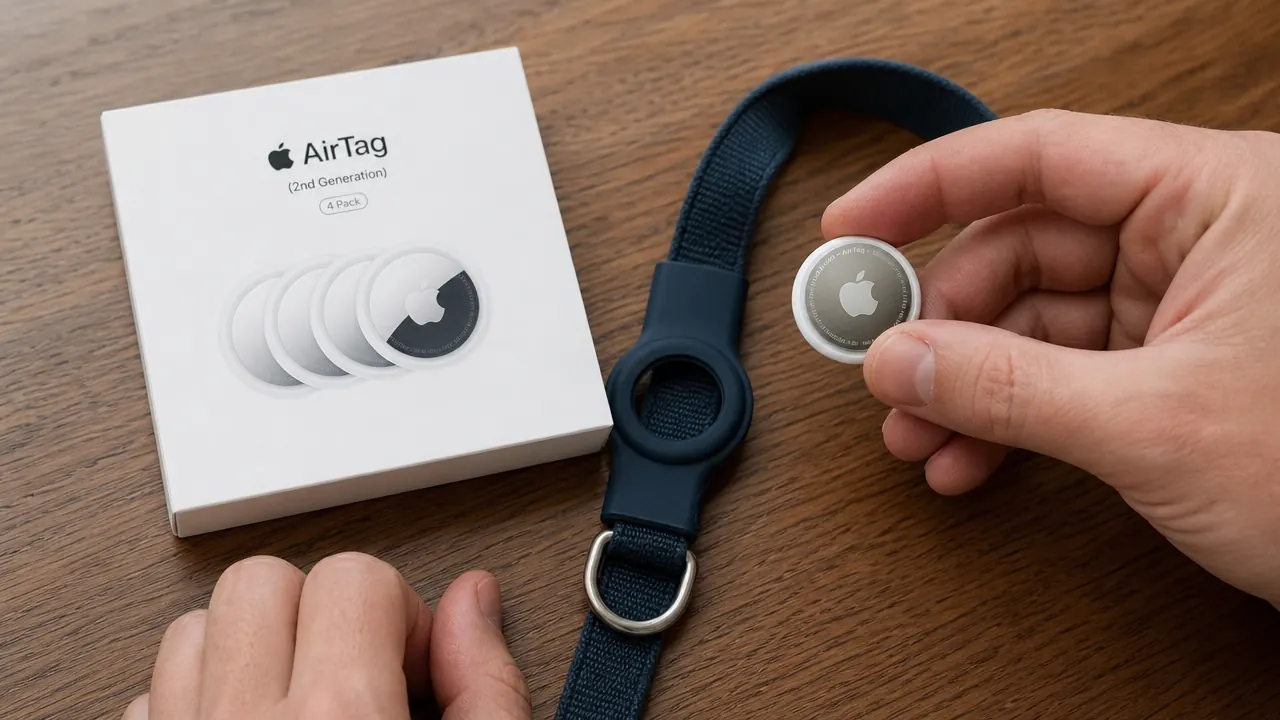
Pepper is a 22-pound terrier mix, about three years old, with a talent for finding gaps in fences. She wears the AirTag in a silicone loop holder attached to her flat nylon collar, positioned just behind her left ear so it does not swing around or catch on anything. The AirTag itself is a polished white disc, 31.9mm wide and 8mm thick, which sounds small until you try to find a collar holder that fits well. More on that in a moment.
Over eight months I have tested the AirTag in our neighborhood walks, at a large off-leash dog park, at a family member's rural property, and during a three-day trip to a mid-size city. Those four environments taught me exactly where the AirTag earns its keep and exactly where it falls short. I replaced the battery once, at the six-month mark, using a standard CR2032 coin cell that cost me about a dollar.
I also used all four AirTags from the pack. One on Pepper, one on my keys, one in a travel bag I check when leaving hotels, and one on my tabby June's breakaway collar. The 4-pack versus single-unit value is real: the pack brings the per-tag price down meaningfully compared to buying singles, and for a household that will use more than one, that math is easy.
How the Find My Network Actually Works for a Lost Dog
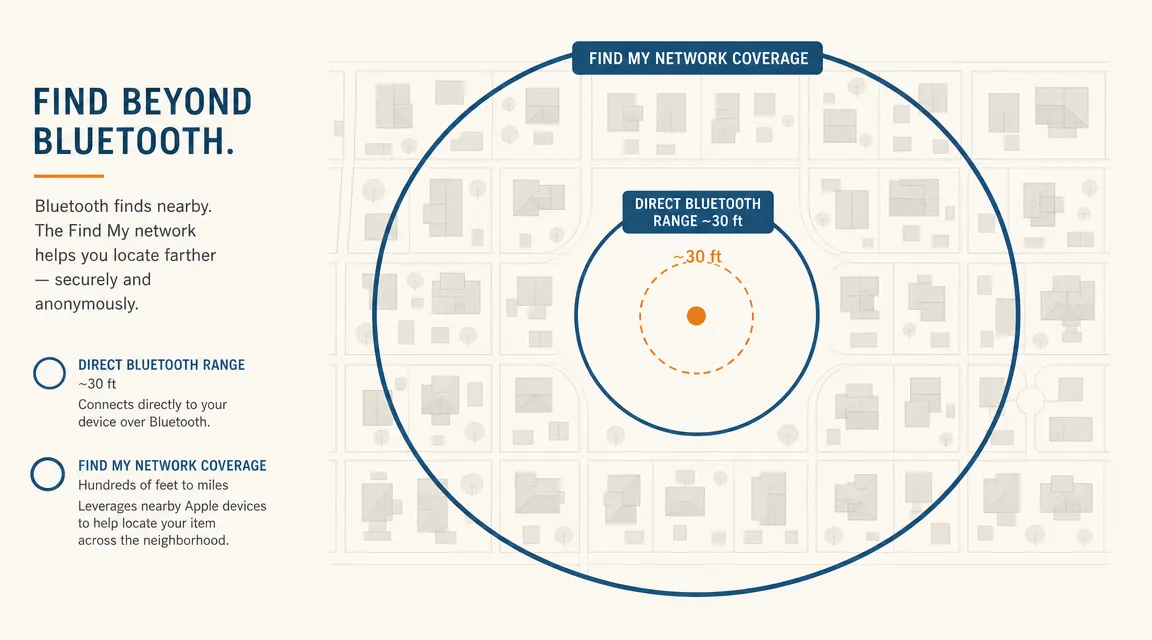
When Pepper is within Bluetooth range of my iPhone, roughly 30 feet in open air and less through walls, the Find My app shows her location almost instantly. If she wanders beyond that direct range, the system switches to passive mode: her AirTag quietly pings any nearby Apple device, and that device relays her approximate location to Apple's servers, which push it to my app. I do not see a constant live track the way I would with a cellular GPS collar. I see the last reported location, which updates whenever a Find My device comes within range of hers.
In our suburban neighborhood, where most houses have an iPhone or iPad somewhere inside, that passive network works surprisingly well. When Pepper got out again in month four through a neighbor's open door, the Find My app showed her location on a street two blocks away within about three minutes, updated as she moved through an area dense with Apple households. I walked to that pin and found her sniffing a garden bed. That experience is why I still recommend this tracker for urban and suburban situations.
At the rural property, the story changed. Five acres of fields, no neighbors visible, and the nearest house a quarter mile away. When I let Pepper roam the fenced pasture and walked inside, the app showed her last known location at the gate where she entered the field. It did not update again until I stepped back outside with my phone. In a truly rural area with sparse Apple device density, the community-find network has real gaps. That is not a flaw in the AirTag specifically. It is simply how Bluetooth-based community-find works.
In our neighborhood, where most houses have an iPhone somewhere inside, the passive Find My network works surprisingly well. When Pepper got out in month four, the app showed her location two blocks away within three minutes.
Collar Attachment: The Part Nobody Warns You About
Apple does not sell a collar attachment in the box. The AirTag ships with a battery pull tab and nothing else for wearables. You need a third-party holder, and the quality range is wide. I went through two silicone loop holders before finding a rigid polycarbonate case with a carabiner clip that actually stays secure. The cheap silicone loops stretch over time and can let the disc spin, which wears the edge and eventually releases the tag. If you order an AirTag for your dog, budget another seven to fifteen dollars for a quality collar case at the same time.
Weight is also worth mentioning. The AirTag weighs 11 grams, and most polycarbonate cases add another four to six grams. At 15 to 17 grams total, it is light enough for a medium or large dog without any discomfort. For a very small dog under 8 pounds, I would consider it borderline. For cats, the silicone loop holders on a breakaway collar work fine weight-wise, which is how I use it on June, though you need to re-evaluate fit more often than with a flat nylon collar.
Precision Finding: The Feature That Surprises People
When you are within Bluetooth range of the AirTag, the Find My app switches to Precision Finding mode on supported iPhones. The screen shows a directional arrow and a distance reading that counts down in feet: 60 feet, 40 feet, 15 feet. The phone's haptics pulse faster as you close in. It is genuinely useful for finding a dog who has wedged herself behind the couch or slipped into a room at a friend's house. The first time I used it to find Pepper hiding under a bed at a vacation rental, I was impressed.
Precision Finding only works when your iPhone is in direct Bluetooth range. It does not work at distance through the Find My network. Think of it as a metal-detector mode for close-range recovery, not a long-range search tool. For that close-range use case, though, it is genuinely better than anything a cellular GPS collar offers, because GPS accuracy at 5 to 10 feet is poor, while Bluetooth Precision Finding can get you to within a few feet.
What I Liked
- No monthly subscription, no ongoing cost after purchase
- Battery lasts approximately 12 months on a standard CR2032
- Precision Finding mode guides you to within a few feet when in range
- IP67 water resistant, holds up to rain and puddle splashing
- The 4-pack price makes it affordable to tag multiple pets and items
- Works seamlessly inside the Apple ecosystem with no separate app to manage
- Lightweight enough for cats and small dogs with the right holder
Where It Falls Short
- Not real-time GPS: location only updates when a Find My device is nearby
- Useless in rural areas or anywhere with low Apple device density
- No collar attachment included in box, third-party case required
- Android households cannot use AirTag at all
- No activity monitoring, geofence alerts, or health data
- Updates passively, not continuously, so location can be minutes old
Battery Life and Water Resistance: Both Hold Up
Apple rates the AirTag battery at about one year. Mine lasted six months before the low-battery notification appeared in the app. That gap from twelve months to six is likely because Pepper's tag pings the network frequently in our dense neighborhood. Higher Find My network activity drains the battery faster. The replacement took about thirty seconds: press and rotate the back cover counterclockwise, swap the CR2032, rotate clockwise to close. The app recognized the fresh battery within a minute.
Water resistance is rated IP67, meaning it can handle submersion up to one meter for thirty minutes. Pepper is not a swimmer, but she walks in rain and has stepped into puddles that came up to her belly. The AirTag has never shown any sign of water damage. For most dogs in most climates, IP67 is sufficient. If your dog is a regular swimmer or lives somewhere with heavy surf exposure, you will want to pair the AirTag with a waterproof case rather than a standard silicone loop.

Who This Is For
The AirTag fits a specific kind of pet owner well. You are in an iPhone household, your dog or cat lives primarily in an urban or suburban neighborhood with decent foot traffic, and you want a safety net without a recurring monthly cost. You understand that the AirTag is not real-time GPS and you are okay getting the last known location through the Find My network rather than a live track. You might also want multiple tags for pets, keys, and a bag, which makes the 4-pack an especially good value. If that description matches you, the AirTag is hard to beat at this price point.
It also works well as a secondary tracker. Some owners run a cellular GPS collar as their primary device and add an AirTag as a backup tag that works at home and in the immediate neighborhood without adding a second subscription. That layered approach costs more upfront but gives you both live tracking anywhere with cell signal and community-find coverage close to home.
Who Should Skip It
Skip the AirTag if you have an Android phone. The Find My network is Apple-exclusive, and while a lost-dog finder app with Android access exists in a limited form, it is a fraction of the functionality. Skip it if your dog regularly runs in rural areas, forests, or anywhere with sparse human foot traffic and few Apple devices. In those environments, the community-find network is thin and you need dedicated GPS. Skip it if your dog is a serious escape artist in a low-density neighborhood and you need to know where she is at any moment regardless of whether anyone with an iPhone has walked by recently. For that situation, a cellular GPS collar with live tracking is the right tool. You can read how the AirTag compares to other no-subscription options in our piece on the best Bluetooth pet trackers without a monthly fee.
I also want to flag anti-stalking protections. Apple built a feature into the AirTag that alerts nearby iPhones if an unknown AirTag has been traveling with them. This is a good thing for human safety but means that if your dog is found and a stranger walks with the dog for a while, they may receive a notification about an unknown tracker. This is not a malfunction. It is a privacy feature working as designed. Knowing this ahead of time avoids confusion.
How It Compares to Other No-Subscription Options
The main alternative in the Bluetooth no-subscription space is Tile. Tile uses its own community network across both iPhone and Android devices, which is an advantage in mixed-device households. The Find My network is larger overall, with over a billion active Apple devices participating, which gives the AirTag a density edge in most urban environments in the US. If everyone in your household has an iPhone, the AirTag wins on network size. If your family is split between iOS and Android, Tile's cross-platform network may serve you better. We walk through that comparison in detail in our AirTag vs Tile for pets guide.
If you want live GPS tracking with no community-find dependency, that requires a cellular subscription product. Trackers like Tractive use a cellular network to push your dog's location to your phone every few seconds regardless of whether any other device is nearby. The tradeoff is a monthly fee, usually eight to fifteen dollars, plus a collar that is larger and heavier. For most backyard dogs and indoor cats, that subscription cost never pays off. For rural dogs, hunting breeds, or dogs with a history of long escapes, it probably does.
If this fits your situation, you are unlikely to find a better value anywhere.
Zero subscription. Battery lasts about a year. Works across a billion Apple devices. If you are an iPhone household in a neighborhood with regular foot traffic, the AirTag 4-pack makes a lot of sense as a primary or backup tracker.
Amazon Check Today's Price on Amazon →