

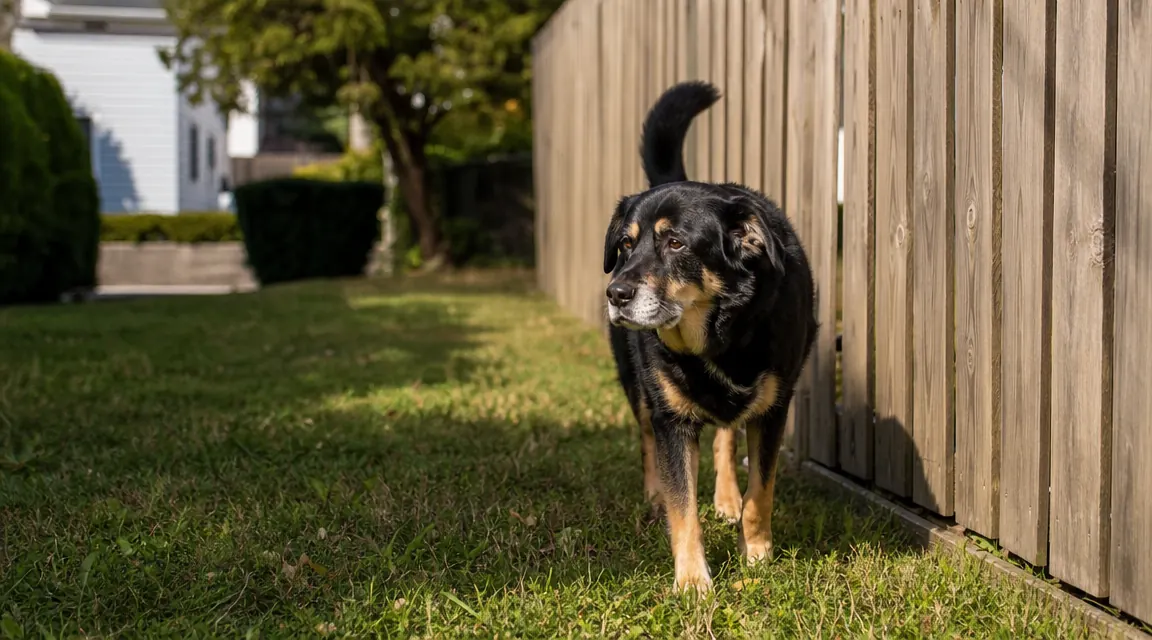
I bought the Fi Series 3+ eight months ago after Loki, my four-year-old husky, got under a fence panel I thought was secure. I was not looking for a fitness tracker for my dog. I wanted to know the second he moved past the yard boundary. What I got was both more and less than I expected, depending on which feature you're asking about.
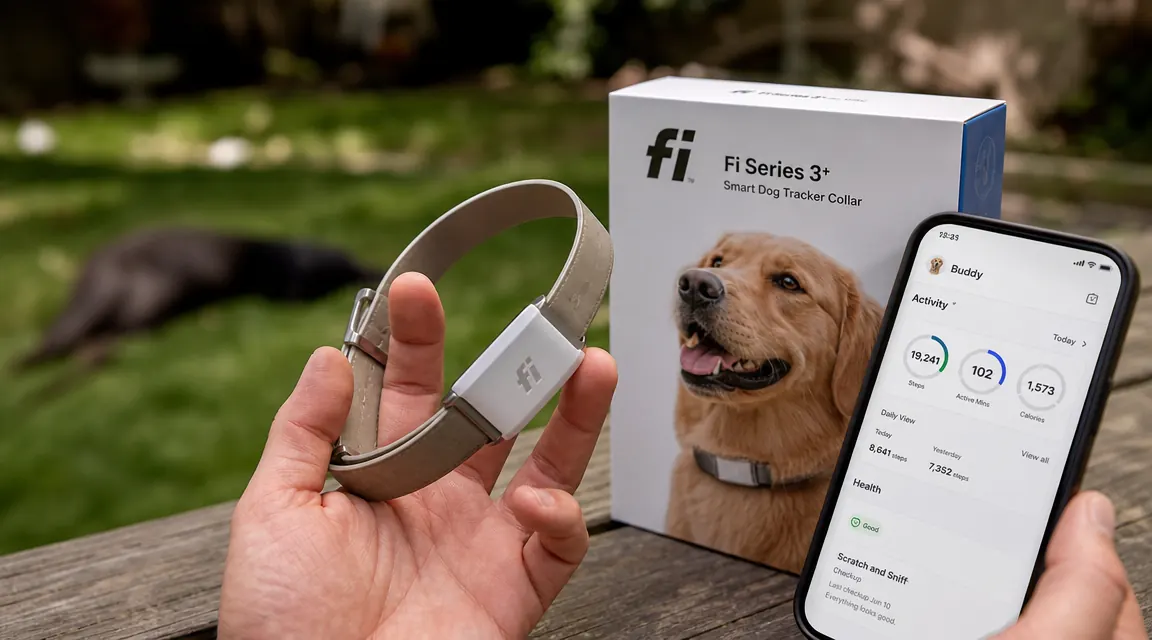
The Fi Series 3+ is a cellular GPS collar with embedded accelerometers that also monitors step counts, activity levels, and sleep quality. This Amazon listing includes twelve months of the Fi membership, which activates the real-time GPS and the full health dashboard. After eight months of daily use on a 62-pound dog who sleeps inside and bolts outside like he's auditioning for a sled race, I have a clear picture of what this device genuinely does well and where the marketing copy quietly glosses over things worth knowing.
The Quick Verdict
The Fi Series 3+ is the best GPS collar for owners who want health and location data in one app, but the GPS accuracy window is narrower than advertised, battery life degrades by month five, and you need to budget for the annual membership renewal after your included year ends.
Amazon Check Today's Price →Want real-time GPS and health tracking in one collar? Check today's price on the Fi Series 3+ with 12-month membership included.
This listing bundles the hardware and the first year of cellular GPS service. After that year, a renewal membership is required to keep live tracking active. Factor that into your total cost before you buy.
Amazon Check Today's Price on Amazon →How I've Used It: Eight Months, Daily Wear, Real Conditions
Loki wears the Fi collar for roughly 18 hours a day. He's outside in the backyard for about three hours, on leash for walks twice a day, and sleeps on a dog bed in the bedroom at night. I live in a suburban neighborhood outside Atlanta with decent LTE coverage, which puts me in what Fi calls the ideal operating environment. I mention that because GPS and cellular performance varies significantly by location, and I want to be honest that my experience is not a worst-case scenario.
I set up a safe zone around the property perimeter using the app's geofence tool in the first week. I also connected Fi's community LTE network, which allows the collar to ping location using nearby Fi base station nodes when available, in addition to standard cellular. Over eight months I have received more than 200 escape alerts, charged the collar more times than I initially expected, and checked the sleep score nearly every morning out of habit. Here is what I actually learned.
The Membership Math: What Year Two Actually Costs
The listing includes twelve months of the Fi membership. That membership is what activates real-time GPS, the escape alert system, the activity dashboard, and the sleep scoring. Without an active membership, the collar can still passively track steps and record motion via the accelerometer, but you lose all the cellular location features. You are left with a moderately expensive fitness tracker without the fitness-tracker-level polish of a dedicated device.
When the included year ends, renewal pricing runs in tiers depending on whether you pay monthly or annually. Annual renewal is meaningfully cheaper per month, but it is still a recurring cost that effectively adds to the total cost of ownership every year you keep the collar. If you are comparing the Fi Series 3+ to a GPS-only competitor that charges a lower monthly subscription, factor twelve months of renewal fees into the comparison before you decide the Fi is the pricier option. It may or may not be, depending on which tier you select.
The free tier, which Fi calls the basic plan, keeps step counting and some historical data accessible. But the location tracking is the whole reason most people buy this collar. If you are not committed to renewing the membership annually, I would recommend a different device. The Fi Series 3+ is genuinely built around the subscription, not just bolted on as an afterthought like some competitors. That is both its strength and its honest constraint.
GPS Accuracy: Where It Shines and Where It Falls Short
In open suburban areas with clear LTE signal, the Fi Series 3+ tracks location with an accuracy window of roughly 10 to 30 feet. That is good enough to tell you Loki is in the backyard versus three houses down, and it's more than sufficient for the escape-alert use case. The map in the app updates in what feels like real time during a live tracking session, with pings coming in every few seconds.
Where accuracy gets more complicated is in areas with heavy tree cover, in dense brick or stucco neighborhoods where LTE signal is variable, or if your dog moves to a location with cellular dead spots. In those conditions, the last known location becomes the active pin, which can be 200 to 400 feet from the dog's actual position by the time you're looking at the map. For urban or heavily wooded environments, that gap matters. GPS-only competitors that use satellite positioning independently of cellular towers can sometimes hold location in those conditions where a cellular-dependent collar loses it. The Fi relies on LTE for live updates, so signal quality is a real variable in your experience.
I want to be specific rather than vague here: in my Atlanta suburb with standard Verizon LTE coverage, the tracking has been reliable enough that I found Loki's exact location three times when he triggered a real escape. Each time I was within 20 feet of him when I arrived at the map pin. That is genuinely useful. But on a camping trip with marginal cellular service, the collar showed his location as fixed for 22 minutes while he was clearly moving around the campsite in front of me. Know your coverage area before you count on pinpoint accuracy in remote spots.
In my Atlanta suburb, I found Loki within 20 feet of the map pin every time he triggered a real escape. On a camping trip with marginal cell service, the pin sat frozen for 22 minutes while he walked around in front of me. The collar is only as accurate as the cellular signal underneath it.
Escape Alert False Positives: What Nobody Warns You About
Over eight months, I received more than 200 escape alerts. Fewer than 10 of those were real boundary crossings. The rest were false positives. That ratio bothered me more than I expected it to. By month three, I had trained myself to treat the phone alert as background noise rather than an emergency, which is exactly the wrong psychological state to be in when the one real escape happens.
The false positives trace back to two root causes. First, the GPS accuracy window of 10 to 30 feet means the collar occasionally registers Loki as outside the geofence when he is sitting just inside the yard boundary. If you draw your safe zone tightly, you will get more false alerts. The workaround is to draw the geofence 20 to 30 feet inside the actual property edge, which requires some trial and error in the app. Second, LTE momentary signal drops can cause the collar to register an ambiguous location that the app resolves to outside the zone until the next ping corrects it. You get a notification, you check the map, the dog is already back inside the zone on the next update.
Fi has iterated on the alert sensitivity in app updates, and the false positive rate has improved since I first set it up. But I would still classify this as a known imperfection rather than a solved problem. If you have a breed that actually escapes frequently, train yourself to verify on the live map before you start running out the door.
Battery Life: The Reality at Month Five and Beyond
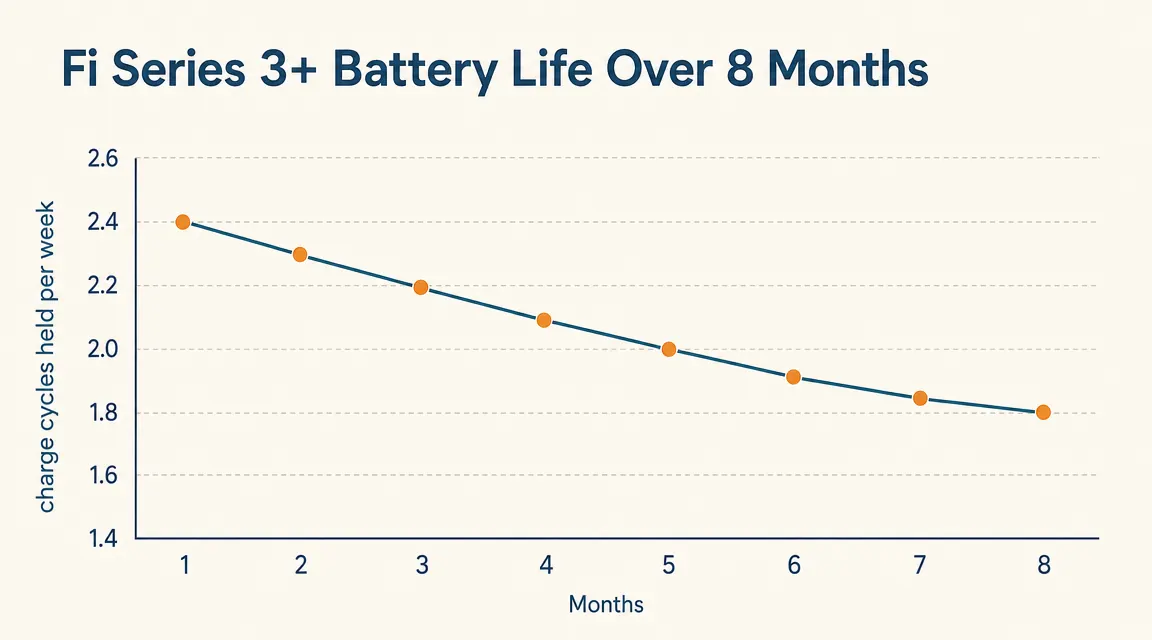
When I first set up the Fi Series 3+, the battery held up for about three to four days per charge on standard settings with GPS pings at normal frequency. By month five, I was charging every two and a half to three days. By month eight, I charge every two days consistently. That is measurable degradation over the course of regular use, and it is worth naming honestly.
Lithium polymer batteries in wearables degrade with charge cycles. The Fi is no exception. You can extend battery life somewhat by reducing GPS ping frequency in the app settings, switching to a lower tracking tier when the dog is inside, or using a Fi base station at home so the collar uses Wi-Fi-adjacent low-power communication rather than cellular. Those settings help. But if you are expecting three to four days per charge to hold steady two years into ownership, calibrate that expectation now rather than later.
The charging connector is proprietary and clips magnetically to the collar module. That is convenient until you lose or damage the charger, at which point you need to order a replacement from Fi directly. The charger is not available through Amazon as a standalone item at the time of this writing, which is a small but real consideration for travel.
Sleep Score Reliability: Useful Trend Data, Not Diagnostic Truth
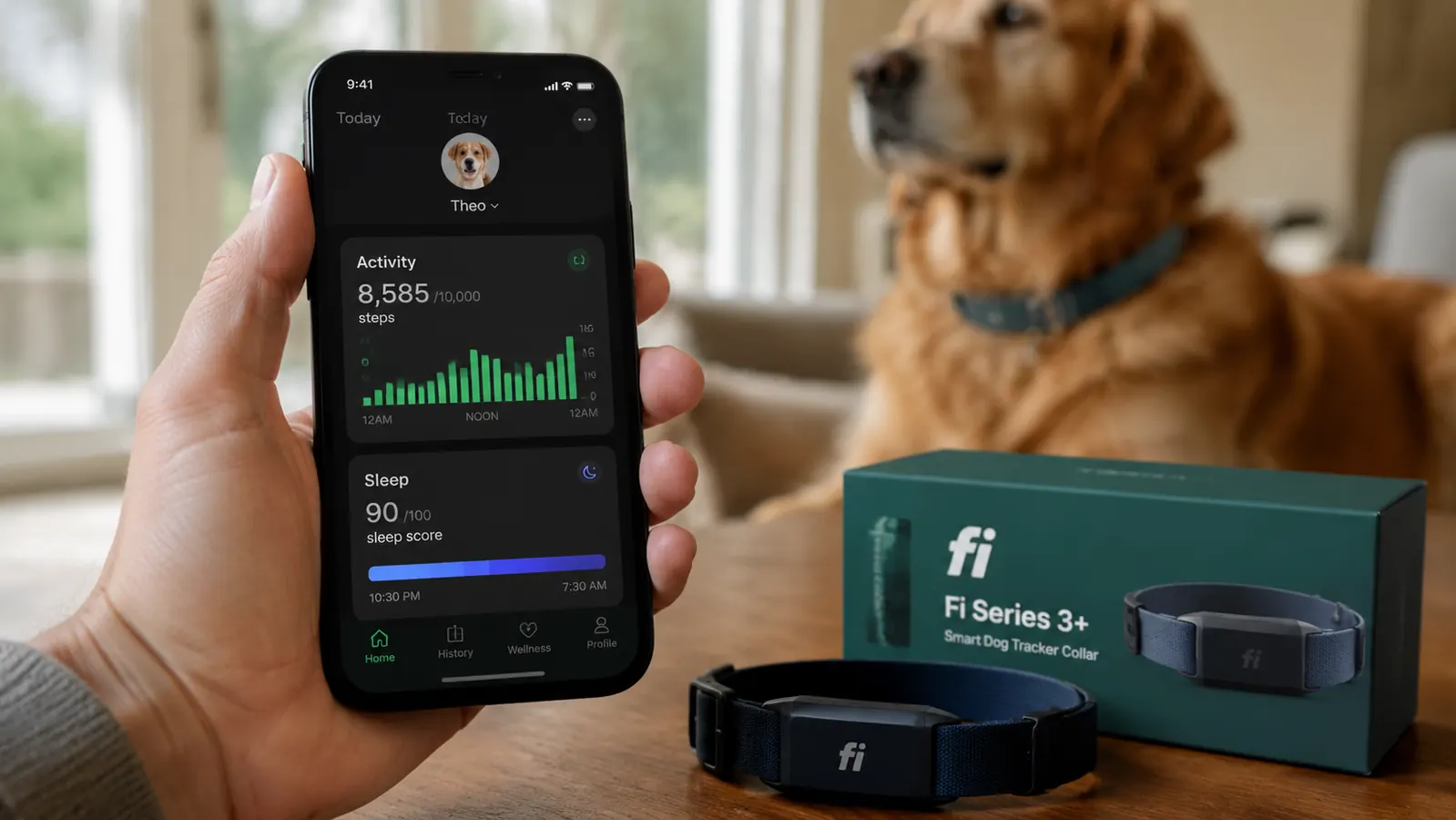
The Fi app generates a daily sleep score for your dog based on motion detected by the accelerometer overnight. The score ranges from poor to excellent and logs the total sleep duration alongside a chart of restlessness periods. I checked this every morning for about four months before settling into a more occasional habit.
For a dog who sleeps deeply and predictably, the sleep score is probably a genuine signal. For a dog like Loki, who repositions frequently and sometimes gets up twice a night to drink water, the score is consistently rated poor to fair even on nights when he appeared to sleep well by any observable standard. The accelerometer reads movement and flags it as restlessness regardless of whether the dog felt rested. You are measuring motion, not sleep quality, and the distinction matters if you are trying to use this data to track health changes over time.
Where the sleep data does become genuinely useful is trend tracking over weeks. If your dog's average sleep duration drops 40 minutes per night over a three-week period and their daytime activity also declines, that pattern is worth bringing to a vet. The collar is not a diagnostic tool, but a sustained behavioral change showing up in the data can prompt a conversation with your vet earlier than you might otherwise have it. That is a real benefit, even if the day-to-day score is noisier than the app implies.
Water Resistance: IP68 Rating in Real-World Use
The Fi Series 3+ carries an IP68 rating, meaning it is rated for continuous submersion up to 1.5 meters for 30 minutes under manufacturer test conditions. In practical terms, this means it handles rain, puddle splashing, and the occasional backyard sprinkler without any issue. Loki has been caught in two heavy rainstorms while wearing it. The collar performed fine both times.
What IP68 does not mean is that the collar is rated for sustained swimming in a lake or pool. Repeated submersion, especially in chlorinated or salt water, can degrade the seals over time. If your dog is a water dog who swims daily, the waterproofing will work in the short term but I would not treat it as indefinite protection. For most suburban and active-trail use cases, the IP68 rating is sufficient and holds up in real conditions. For water-retrieving dogs who go in ponds or ocean surf regularly, factor that wear into your expectations.
What I Liked
- Cellular real-time GPS that actually updates every few seconds in good coverage areas
- Genuinely useful activity and step-count data for spotting long-term health behavior shifts
- Twelve months of membership included in the Amazon listing, making the first-year total cost clear
- Solid IP68 water resistance for everyday outdoor conditions including rain and puddles
- Lightweight module sits low on the collar and Loki stopped noticing it after day three
- App is one of the better-designed pet tracking apps in this category, with clear data layout and good geofence controls
Where It Falls Short
- GPS accuracy depends heavily on LTE signal quality and degrades meaningfully in rural or dead-zone areas
- False escape alerts are a real issue, particularly with tight geofence settings, and take time to tune out
- Battery life degrades with charge cycles over months, dropping from roughly 3.5 days to under 2 days by month eight
- Membership renewal is required after year one to keep real-time GPS active, adding ongoing cost every year
- Proprietary charger is not sold standalone on Amazon, creating a single point of failure for travel
- Sleep score is motion-based, not sleep-quality-based, and consistently underscores restless breeds
How It Compares to GPS-Only Competitors
If you only need real-time GPS location and escape alerts, there are cellular GPS collars on the market with lower hardware price points and lower monthly subscription costs. Tractive is the most direct comparison in the cellular-GPS-only space, with a lower upfront price and a cheaper monthly plan. You give up the activity monitoring and sleep scoring in exchange for the cost savings. If those health features genuinely do not interest you, the savings are real.
The Fi Series 3+ earns its premium in the combination of GPS and health data in a single app and a single collar. The activity tracking is meaningfully better than bolted-on step counting in cheaper collars. The Fi community network, which boosts location detection via nearby Fi collars and base stations, is a genuine infrastructure advantage in neighborhoods with high Fi adoption. Whether that combination is worth the price differential depends entirely on how much you would actually use the health monitoring features. If your answer is 'not much,' the premium is hard to justify on GPS alone.
Who This Is For
The Fi Series 3+ is the right collar for owners who want both real-time location and health monitoring in one device and are willing to pay for a quality membership to keep both features active. It is particularly well-suited to owners of active breeds who exercise regularly and want data that reflects their dog's actual activity levels over time, not just a location ping when something goes wrong. Tech-comfortable owners who will open the app daily and use the data thoughtfully will get the most from this collar. If you live in an area with solid LTE coverage and have a breed that actually pushes your fence boundaries, the combination of escape alerts and health trending is genuinely hard to replicate with two separate devices.
Who Should Skip It
If your primary need is low-cost GPS location tracking and you have no interest in activity or sleep data, there are simpler cellular trackers at a lower ongoing cost that will serve you better. If you live in a rural area with marginal LTE coverage, the GPS accuracy gap in low-signal conditions may be a dealbreaker for the exact emergency situation you are buying this collar for. If you have a water-retrieving dog who swims daily, factor the long-term IP68 seal wear into your decision. And if budget is tight, plan the annual membership renewal cost before you commit to the hardware, since the collar without an active membership is a limited device.
Eight months in, I still wear it on Loki every day. Here is what you need to know before you order.
The Fi Series 3+ with 12-month membership included is the clearest entry point into the Fi ecosystem. Budget for annual renewal after year one. The GPS is reliable in good LTE coverage and the activity data is the best in this category for health trend monitoring over time.
Amazon Check Today's Price on Amazon →