
Loki figured out how to open the side gate the first week we moved into our new house. He is a two-year-old husky, 58 pounds, and deeply committed to the idea that the whole neighborhood is his territory. After the third escape, I stopped patching fences and started looking at GPS collars. What I did not expect was to end up genuinely caring about his sleep score.
The Fi Series 3+ is marketed as a smart dog collar, not just a tracker. It does cellular real-time GPS location, but it also logs daily steps, monitors sleep quality, and compares your dog's activity against similar breeds. I have been using it on Loki for six months now. Here is everything I have learned, including the parts that surprised me and the one honest downside you should know before you buy.
The Quick Verdict
A genuinely useful all-in-one collar for dog owners who want both cellular GPS security and meaningful health data. The first year is included. Budget for the ongoing membership after that.
Amazon Check Today's Price →Your dog went somewhere he should not be. Do you want to know right now, or find out later?
The Fi Series 3+ sends an escape alert the moment Loki crosses a boundary I set. It also tracks his steps and sleep, so I have a health baseline, not just a location dot. The 12-month membership is already included in today's price.
Amazon Check Today's Price on Amazon →How I've Used It
I have been running the Fi Series 3+ on Loki for roughly 26 weeks, through a wet Pacific Northwest spring and into summer. He wears it around the clock except for baths. We live in a suburban neighborhood with a backyard, but we also do two or three off-leash hikes a month in areas with moderate cell coverage. I tested the tracking in all of those contexts.
Setup took about 15 minutes: download the Fi app, scan the QR code on the collar, set up a home safe zone by drawing a boundary on a satellite map, and activate the included 12-month membership. The collar arrived charged to about 70 percent and was tracking within a few minutes of activation. I set a boundary that covers my yard with a small buffer and got the first escape alert the following Saturday when Loki pushed through a loose board. The alert hit my phone in under a minute.
Day-to-day, I mostly glance at the step count and sleep report each morning without opening the app. Fi sends a daily digest to my phone. The map is there when I need it. I checked it actively during hikes and a few times when Loki was unusually quiet, which usually means he found something suspicious.
Cellular Real-Time GPS: How It Actually Performs
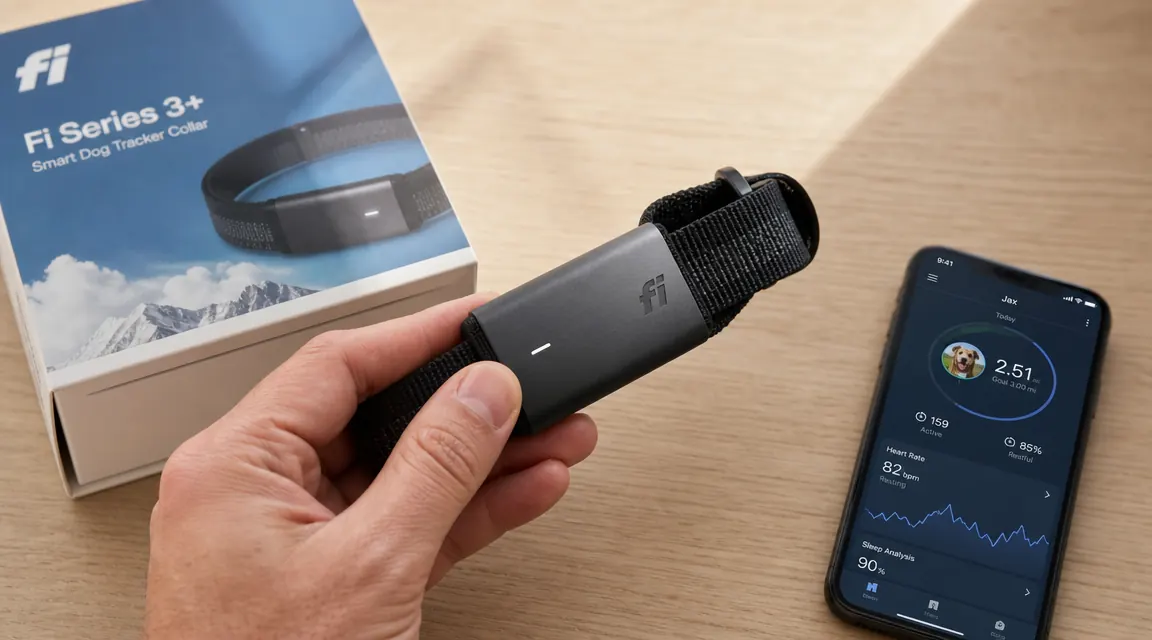
The Fi Series 3+ uses cellular networks for location, not a satellite-to-handheld radio like hunting dog systems. In practice, that means it works wherever your cell carrier has coverage, and it reports location to the Fi app on your phone or any browser. You do not need a separate handheld unit. Loki's location updates every 30 seconds in normal mode and switches to faster updates automatically when he leaves a safe zone or when I tap 'Find My Dog' in the app.
In the neighborhoods around my house, accuracy has been solid. When I checked the map against where I could see Loki in the yard, the dot was typically within 30 to 40 feet. On hikes in areas with decent LTE coverage, I tracked him running ahead of me and the dot stayed close to accurate. In one canyon section with weak signal, there was a lag of two to three minutes before the location refreshed. The collar caches the route and catches up when signal returns, which is useful for playback, but it does mean real-time tracking has a ceiling tied to your carrier.
Basic GPS-only trackers like the Tractive or older Whistle models do one thing: tell you where your dog is. The Fi Series 3+ does that, too, but the cellular connection also carries the health and activity data. That is the practical difference between this collar and a simpler tracker. If location alone is all you need, there are cheaper options. If you want health monitoring layered on top of GPS, the Fi is one of the few collars that actually delivers both.
Activity Tracking and Step Counting: More Useful Than I Expected
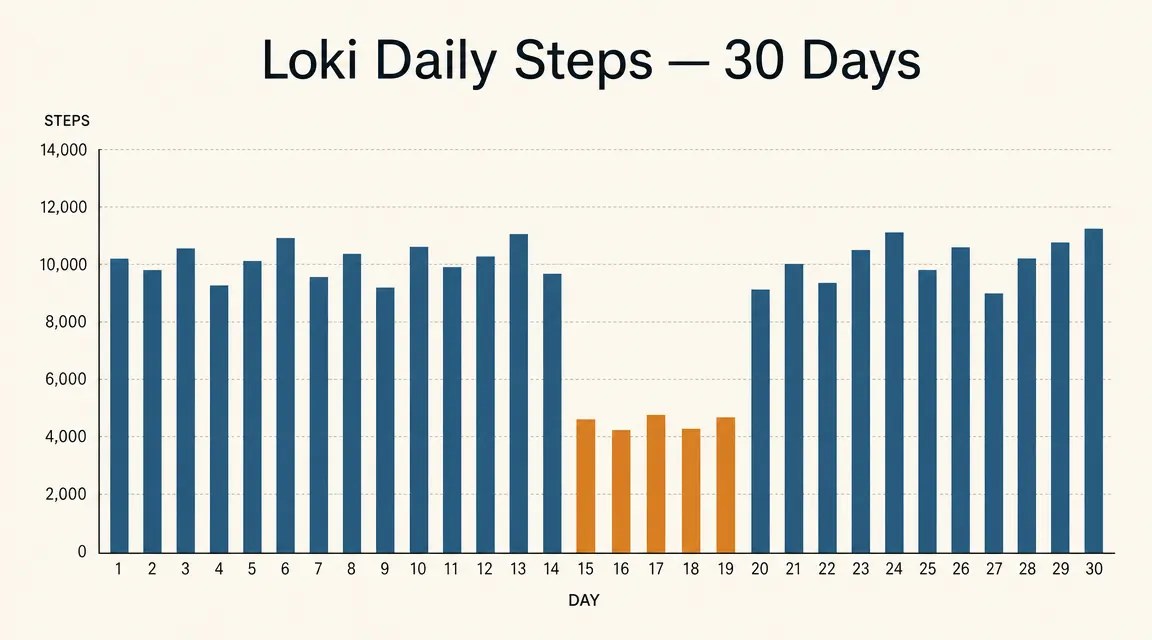
I was skeptical about step counting for dogs. It sounded like a feature that would feel gimmicky after a week. Six months later, I check it almost every day. The reason is simple: when a dog's step count drops significantly from their baseline, something is usually going on. In February, Loki's daily steps fell from his normal 9,000 to 10,500 range down to about 4,800 for five days in a row. No obvious injury. No limp. But the numbers did not lie. I took him in, and the vet found a small foxtail buried in his left paw that had started to cause mild irritation.
The step count drop was the only signal I had that something was wrong. He was not visibly limping. Without the data, I probably would have waited another week.
The Fi app builds a breed-adjusted activity baseline over the first few weeks of use. Huskies are high-activity dogs, and the app knows that. It does not flag Loki as 'low activity' on a 9,000-step day the way it might for a Cavalier King Charles Spaniel. The breed benchmarks feel accurate based on what I know about the breed.
Step goals are customizable. You can set a daily target and the app tracks progress with a ring indicator similar to an Apple Watch. I find this more useful during the winter months when it is easy to let walks get shorter without realizing how much Loki's daily movement has dropped.
Sleep Monitoring: Genuinely Interesting, Not Medically Diagnostic
The Fi Series 3+ tracks when Loki sleeps, how long he sleeps, and assigns a daily sleep score. The score runs from 0 to 100 and factors in total duration, consistency, and restlessness. Loki usually scores between 72 and 88. Nights when I have kept the light on late or there was a storm, his score dips into the 50s.
I want to be clear about what this is and is not. It is a behavioral sensor on a collar. It detects movement, or the absence of it, and infers sleep. It is not a medical-grade sleep study. If your dog has sleep apnea, this collar will not diagnose it. What it does well is surface patterns over time. If a dog that normally sleeps nine hours a night is suddenly sleeping 11 and scoring low on restlessness, that is worth noting. If a dog that is usually still at night starts logging high restfulness scores but is exhausted during the day, that might prompt a conversation with your vet.
For most dog owners, the sleep data functions as a rough wellness check. It is one more data point alongside steps, appetite, and coat condition. I have come to think of it that way rather than expecting clinical precision.
Escape Alerts and Lost Dog Mode
Safe zone alerts are the feature that sold me on this collar in the first place. You draw a custom boundary on a satellite map in the app. When Loki crosses it, the collar switches to continuous faster tracking and my phone gets a push notification. The alert I got during Loki's Saturday fence escape arrived about 50 seconds after he slipped through the board. By the time I walked out the front door, I could see on the map which direction he had gone.
Lost Dog Mode is a separate feature you activate manually when your dog is genuinely missing. It increases the tracking rate and shares a live tracking link you can send to friends, family, or post on neighborhood social apps so other people can help track the dog's location in real time. I have not needed it beyond a test run, but the concept is solid. The more people who have the link, the faster a lost dog gets found.
One honest limitation: all of this depends on cellular coverage. In a dead zone, the collar cannot transmit. It will cache the route and upload when coverage returns, but you will not get real-time alerts in an area without a signal. This is a tradeoff inherent to any cellular tracker, not specific to Fi. Know your local coverage before depending on any GPS collar for off-grid use.
Battery Life: Multi-Week Claim, Real-World Results
Fi advertises multi-week battery life. In normal use, that has held up. Over six months, Loki's collar has typically needed charging every 10 to 14 days, depending on how much active tracking we do. During a weekend hiking trip where I had the app open frequently and the collar was pinging location more often, the charge dropped faster and I needed to top it up after about six days.
Charging is magnetic and takes about two hours from near-empty. The collar does not need to come off to charge if you use the charging clip correctly, though Loki thinks the process is suspicious and insists on investigating the cable. The LED indicator turns solid white when full. I have not once had the collar die unexpectedly. Compared to cellular trackers that need charging every two or three days, this is a meaningful practical advantage.
What I Liked
- Cellular real-time GPS with escape alerts that fire within a minute of boundary crossing
- Genuine health monitoring: daily step count, sleep score, and breed-adjusted activity baseline
- Multi-week battery life in typical use, 10 to 14 days between charges
- Lost Dog Mode shares a live tracking link with anyone you choose
- 12-month membership is already included in the purchase price, so year one is all-in
- App is well-designed and the daily digest makes it easy to stay on top of health trends
Where It Falls Short
- Ongoing membership required after the included year, which adds to the long-term cost
- Cellular coverage is a hard dependency: no signal means no real-time tracking
- At $189 with membership included, the upfront price is higher than basic GPS-only trackers
- Sleep monitoring is behavioral inference, not medical-grade data
The App Experience
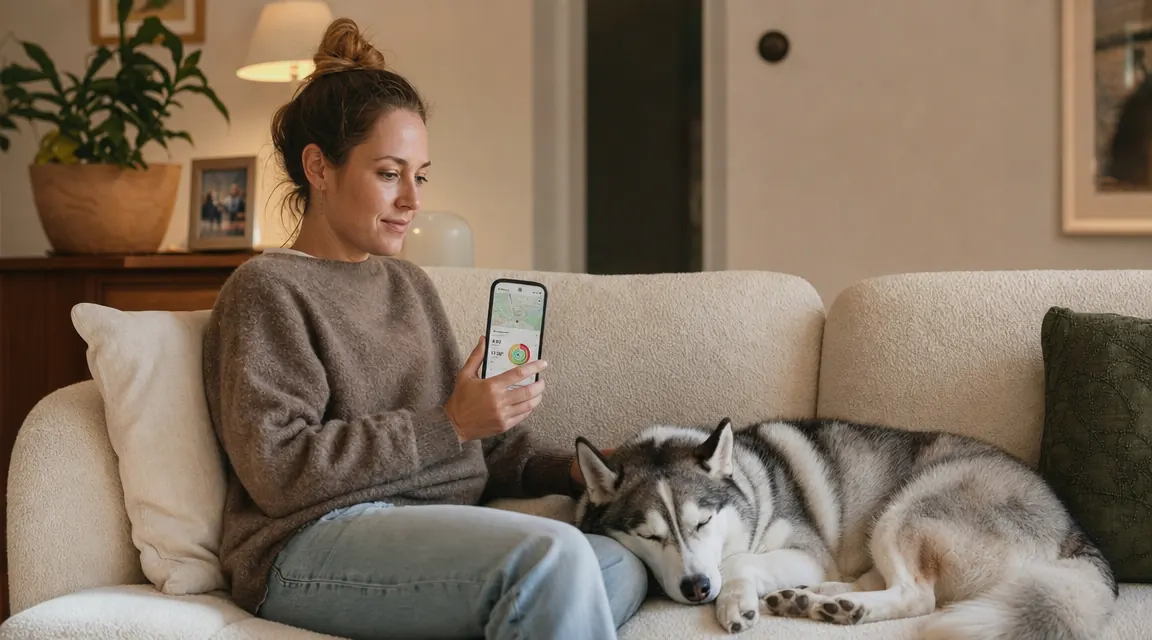
The Fi app is one of the better-designed pet tech apps I have used. The map is responsive and the safe zone editor is intuitive. You can see Loki's current location, his recent route, his step count for today versus his seven-day average, and his sleep score from last night, all on the home screen without digging through menus. Notifications for safe zone exits come through cleanly on both iOS and Android.
The social aspect of the app, a community feed where Fi users share dog photos and activity streaks, is easy to ignore if you are not into it. I turned off community notifications on day two and never missed them. The core tracking and health features are completely separate from the social layer.
Membership Cost After Year One
This is the part I want to be straight with you about. The 12-month membership is included with the purchase of this bundle. After year one, you pay a recurring membership fee to keep the cellular GPS and health features active. Fi offers monthly and annual billing options, and the annual rate works out to a lower per-month cost. The exact current pricing is listed on Fi's website and may change, so check before you commit.
If you are the kind of person who will actually use the GPS and health features, the membership is worth calculating as part of the total cost of ownership. If you want GPS tracking for a year and then plan to cancel, this bundle gives you a full year with no additional subscription charge from the start. That is a real advantage over some competitors who bundle a shorter trial or charge the subscription on top of the device immediately.

How It Compares to Basic GPS-Only Trackers
If you want a pure GPS tracker with no health monitoring, there are less expensive options. A Tractive or similar cellular tracker will show you your dog's location and not much else. For a dog owner who only needs a location dot, that might be the right call. But if you have ever wanted to know whether your dog is getting enough exercise, or whether that two-day lethargy is a blip or a pattern, the health data on the Fi is the piece that tips the value calculation. I covered the step-based early detection of Loki's foxtail situation above. That one vet visit easily paid for the difference in collar price.
I wrote a direct comparison between the Fi Series 3+ and the Tractive if you want to see them side by side on price, features, and which type of owner each serves best. You can also read about the specific reasons health-conscious dog owners upgrade from basic trackers to smart GPS collars if you want more context on the category difference.
Who This Is For
The Fi Series 3+ is the right collar for dog owners who want both GPS security and meaningful daily health data in a single device. If you have a high-energy or escape-prone breed, live near a busy road, or have a senior dog whose activity and sleep patterns you want to monitor, this collar delivers on all of those needs. The 12-month membership inclusion makes the first year a clean, one-price purchase. Husky owners, Beagle owners, and anyone who has already lost a dog once will feel the value immediately.
Who Should Skip It
If your dog lives entirely indoors, never leaves your sight, and you have no interest in activity or sleep data, the Fi is more collar than you need. A less expensive cellular tracker or even a Bluetooth tag may be sufficient. Similarly, if you need tracking in areas with genuinely no cellular coverage, such as deep backcountry hunting or remote hiking, a dedicated off-grid GPS system like the Garmin Alpha is a better fit. The Fi depends on cell signal. That is not a flaw; it is just the architecture. Know your use case before you buy.
Six months in, I would buy this collar again without hesitation.
The escape alerts work. The health data caught something my eyes missed. And the battery lasts long enough that charging feels like a minor errand, not a daily chore. The 12-month membership is already included in today's price, so year one is completely covered.
Amazon Check Today's Price on Amazon →