
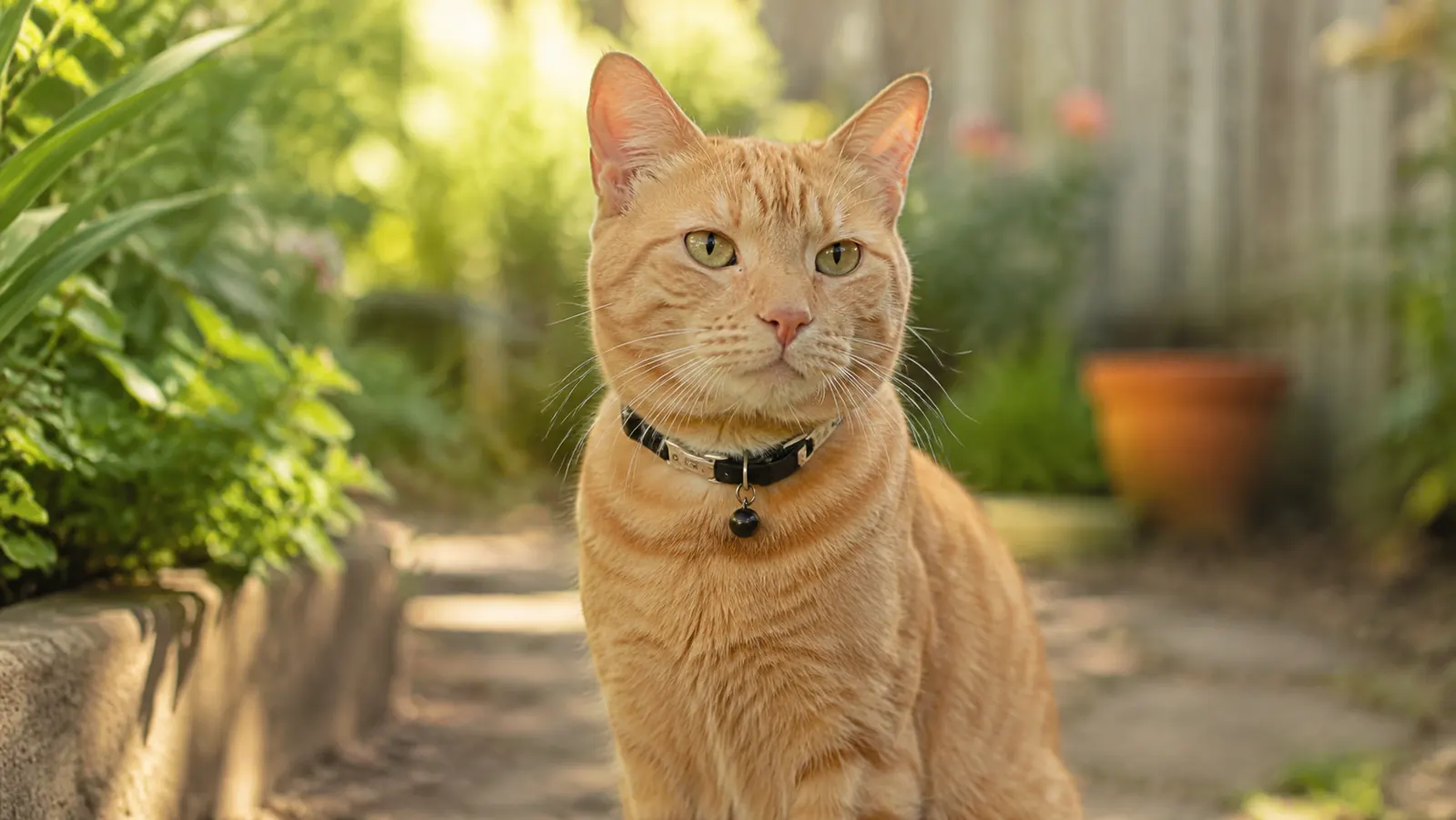
When my tabby June slipped out a propped-open door last spring, my first instinct was to open my phone and search for a GPS cat tracker. I found plenty of options, and almost every one of them had a monthly subscription attached. Some were $8 a month. Some were $14. A few of the fancier collars were nearly $20 a month. That adds up fast, and the recurring cost felt wrong for a tracker I hoped I would rarely need to use.
What I eventually landed on was the Tabcat V2, a radio-frequency homing tracker designed specifically for cats. No monthly subscription fee. No app. No cellular plan. Just a small tag that clips to June's breakaway collar and a handheld receiver that points you toward her like a compass. I have been using it for several months now, and this guide walks through exactly how to set it up, how to use it, and what to realistically expect from a tracker that works without any ongoing cost.
No subscription. No app. Just a signal pointing you to your cat.
The Tabcat V2 comes with two lightweight homing tags and a handheld directional receiver. One purchase, no ongoing cost, and it works the moment your cat goes somewhere they should not be.
Amazon Check Today's Price on Amazon →Why a No-Subscription Cat Tracker Makes Sense for Most Cat Owners
Before getting into the steps, it helps to understand what kind of tracker the Tabcat V2 actually is. A lot of pet trackers marketed online use cellular GPS networks, which means they work the same way your phone's maps do. The tracker pings a cell tower, calculates its location via satellite, and sends that location to an app. That capability is genuinely useful, but it requires a cellular data plan, which is where the monthly fee comes in.
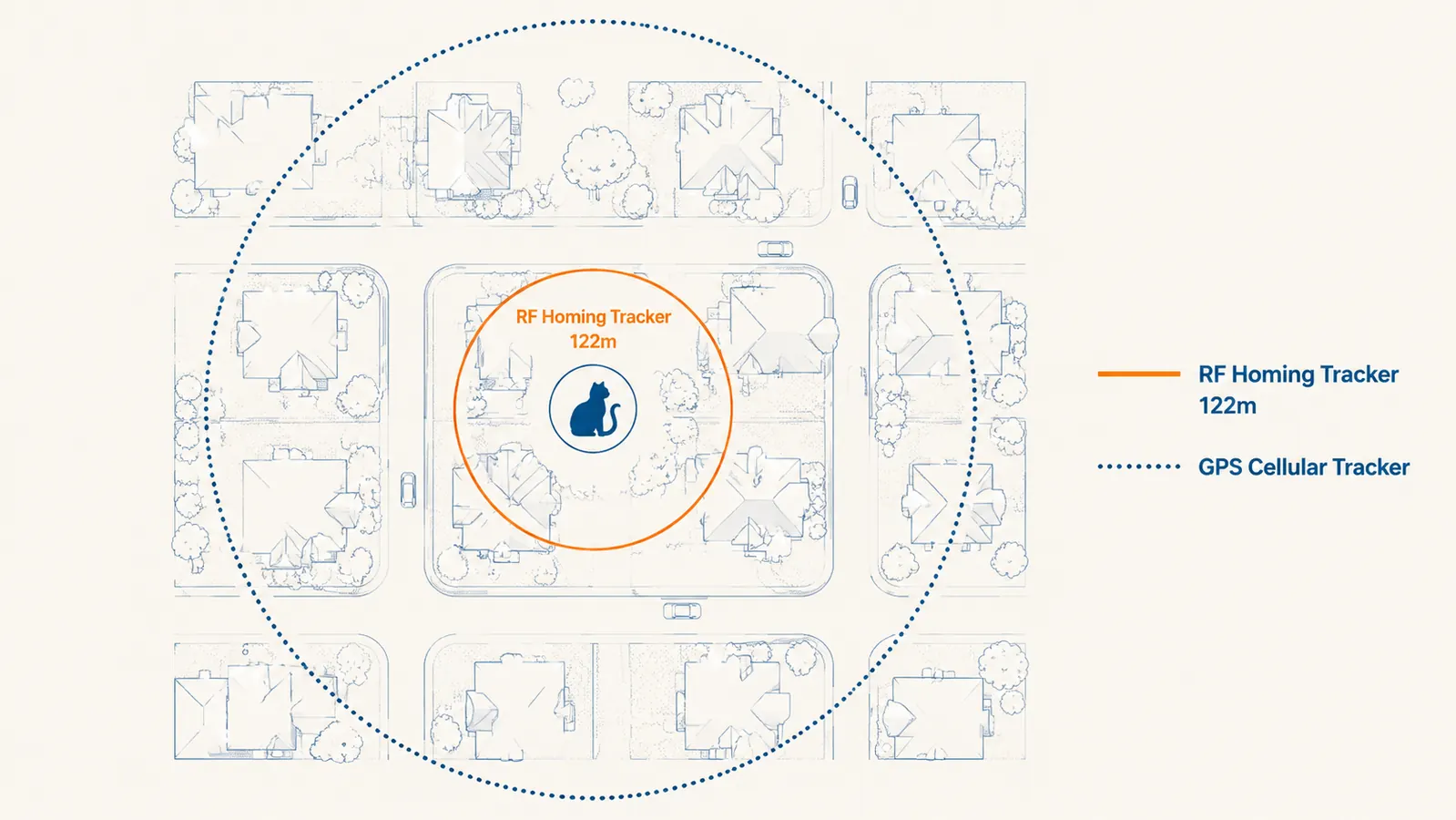
The Tabcat V2 works differently. It uses radio frequency, the same underlying technology as older wildlife research collars. The handheld receiver you carry emits a signal, and the tag on your cat's collar responds. As you walk toward your cat, the beeping gets faster and the directional arrows on the receiver screen point more precisely. You follow the signal, and within a minute or two you have found your cat. There is no map view, no live satellite dot, and no need for a cell signal at all. The range is about 122 meters in open outdoor space and significantly less through walls, but that covers most situations where a cat wanders out of sight.
For cats who roam indoors-only with occasional escapes, or who stay in a yard or nearby neighborhood, a radio-frequency tracker without a subscription is usually plenty. If you have an outdoor cat who regularly disappears for hours across a wide territory, a GPS cellular option handles that better. But for the vast majority of worried cat owners who just want to find a cat that slipped out the door or is hiding inside the house, the Tabcat approach is genuinely effective and costs nothing after purchase.
Step 1: Choose the Right Tag Size for Your Cat's Weight
The Tabcat V2 comes with two homing tags in the box. The tags are small oval devices, and the system is rated for cats weighing at least 1.2 lbs. If you have a kitten under about six months old or an unusually small adult cat, check the weight before attaching. Most adult domestic cats fall well within the comfortable range. The tag weighs around 6 grams, which is light enough that most cats stop noticing it after a day or two.
If you have more than one cat, the two included tags are a practical bonus. You can pair both to the same handheld receiver and switch between them using the receiver's channel button. Each tag has its own distinct signal, so you can press channel one to find cat A and channel two to find cat B. No second receiver needed.
Step 2: Attach the Tag to a Breakaway Collar Safely
This step matters more for cats than it does for dogs. Cats are climbers and can catch a non-breakaway collar on a branch, a fence post, or a piece of furniture in a way that becomes a safety hazard. A breakaway collar, sometimes called a safety release collar, is designed to unclip under pressure so the cat can pull free if they get snagged. Always use a breakaway collar with the Tabcat tag, not a standard flat buckle collar.
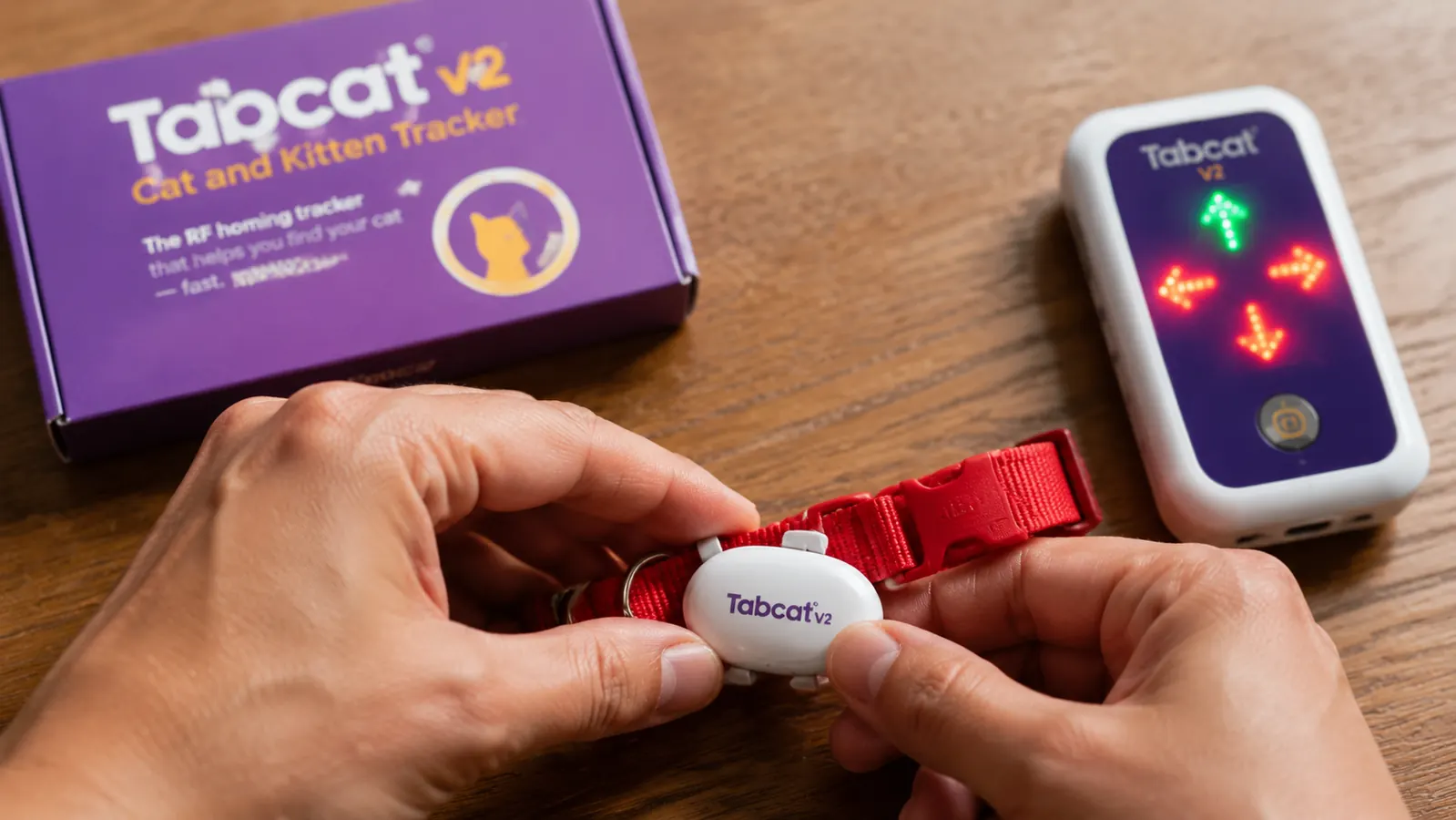
The Tabcat tag clips onto the collar using a simple attachment loop. Thread the loop through the collar and secure it so the tag hangs below the collar rather than sitting on top of it. This keeps the tag from rubbing on the cat's jaw or chin when they lower their head. Leave enough collar slack that you can slide two fingers between the collar and your cat's neck. If it is too tight the cat will be uncomfortable; too loose and the collar can catch on things or come off unexpectedly.
Give the collar a day or two on your cat before an escape scenario tests it. Watch for signs of irritation at the neck or obsessive scratching at the collar area. Most cats adjust quickly and the tag becomes just another part of wearing a collar.
Step 3: Pair the Tag to the Handheld Receiver
The Tabcat V2 receiver comes partially set up from the factory, but you will want to confirm the pairing before your cat ever goes missing. The pairing process is quick. Power on the handheld receiver by pressing the main button. Select the channel you want to assign (channel 1 for your first cat, channel 2 for your second). Then press and hold the pairing button on the tag itself until the receiver confirms the connection with a series of beeps.
Once paired, press the locate button for that channel on the receiver while you are standing near your cat. You should hear the receiver begin beeping and the tag on the collar may click very faintly. The receiver screen will show directional arrows. Walk slowly in a small arc and watch whether the signal gets stronger or weaker. If the arrows point consistently toward your cat and the beeping speeds up as you move closer, the pairing is working correctly. Run this test in your home before you need the device in a real situation.
Step 4: Practice the Directional Homing Technique Before You Need It
The skill of using a radio-frequency tracker is slightly different from following a GPS dot on a map. With a map, you see a static location and walk to it. With a homing signal, you are reading a dynamic signal that changes as you move. The technique takes about ten minutes to learn and is worth practicing while your cat is somewhere you can see them.
Hold the receiver flat and level, at about waist height. Press the locate button and begin walking slowly. Do not spin in place or wave the receiver around. Instead, walk in a steady direction for five or six steps, then stop and hold still. The receiver arrows will settle and show you which direction is producing the strongest signal. Rotate your body slowly until the arrows center, then walk that direction again. Think of it as less like checking a map and more like tuning in a radio station. The signal sharpens as you orient correctly.
Practicing indoors is especially useful because walls reduce the range and can bounce the signal in unexpected directions. If your cat is hiding behind an appliance or inside a closet, you may need to sweep room by room until the signal strengthens. Outdoors, the open-air range is strong enough that you can often pick up the signal from across a yard or two before you have even opened the gate.
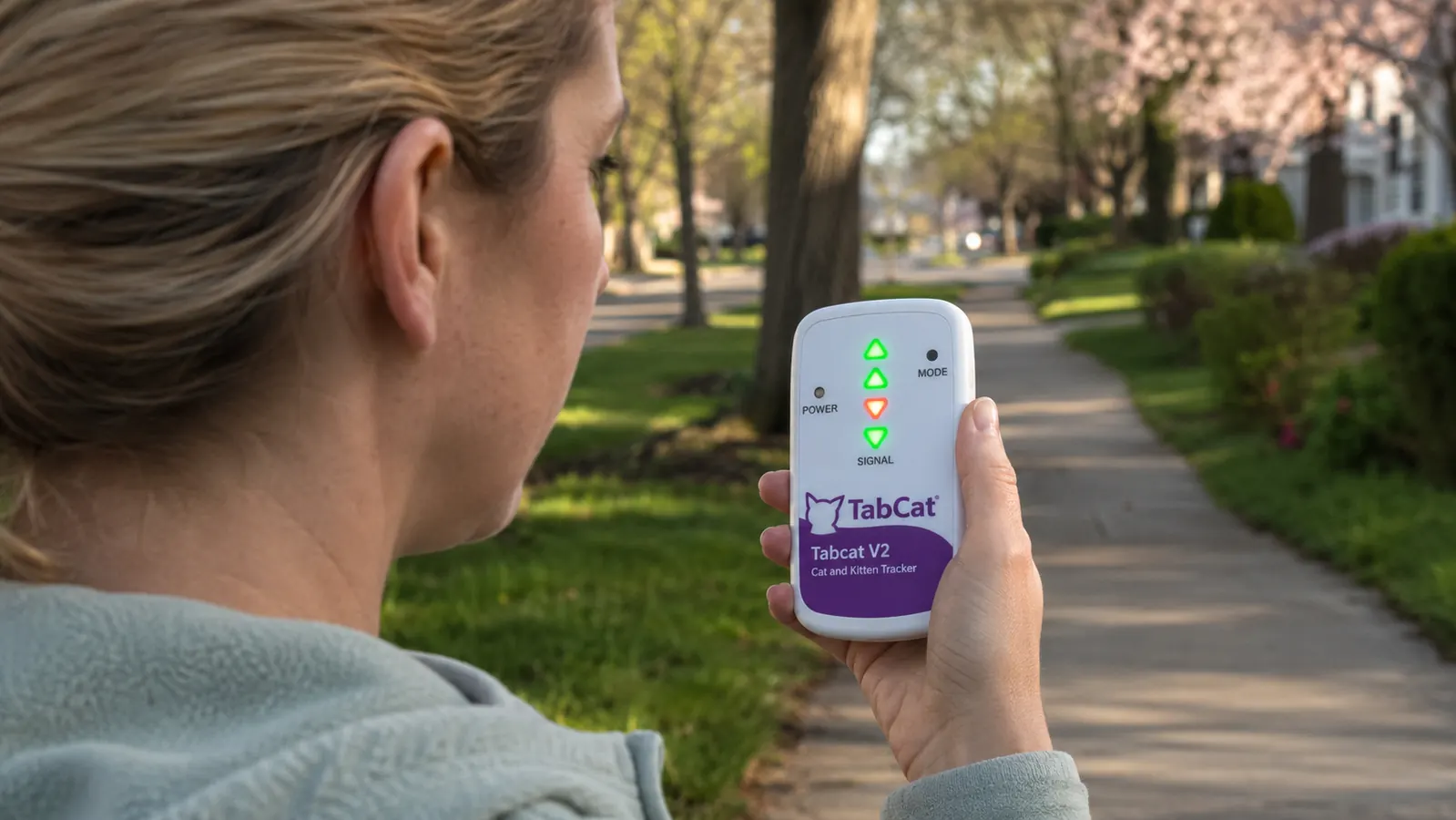
You are not following a dot on a map. You are following a signal that gets louder as you get closer. It takes about ten minutes to learn and works through walls, fences, and garage doors.
Step 5: Build a Daily Wear and Battery Check Routine
The Tabcat tag runs on a CR2032 coin battery, the same flat round battery used in key fobs and some watches. Battery life is rated for around six months of daily wear, though this varies with how often the receiver actively pings the tag. If you run daily locate tests the battery drains faster. If the tag sits quietly on your cat's collar and is only triggered during an actual escape search, six months is a reasonable estimate.
Set a calendar reminder every two to three months to check the battery. The easiest way to check is to run the pairing test: press locate and count how quickly the receiver beeps. A strong, rapid beep means the battery is healthy. A slow, labored beep is the tag telling you it needs a fresh battery. CR2032 batteries cost almost nothing and are available at any pharmacy or hardware store. Keep a spare or two in the drawer where you store the receiver.
Also check the collar fit during your battery check routine. Cats can gain or lose weight gradually, and a collar that fit perfectly in spring may be too snug by winter. The two-finger rule still applies. Collar fit and battery health are the two most common reasons a tracker fails when you actually need it.
Step 6: What to Do When Your Cat Actually Escapes
When June slipped out that spring afternoon, the thing that slowed me down was not the tracker. It was that I panicked and forgot which drawer I had put the receiver in. That is worth knowing in advance: store the receiver somewhere obvious and always-accessible. I keep mine on the same shelf as June's food, which means I walk past it every day and it is the first thing I think of when I cannot find her.
When an escape happens, resist the urge to run outside and start calling your cat's name. Cats often hide when they are scared and calling to them in a stressed voice can make them stay hidden. Instead, take thirty seconds to grab the receiver, power it on, and select the correct channel. Then walk to the last place you saw your cat and begin the slow, deliberate homing technique you have already practiced.
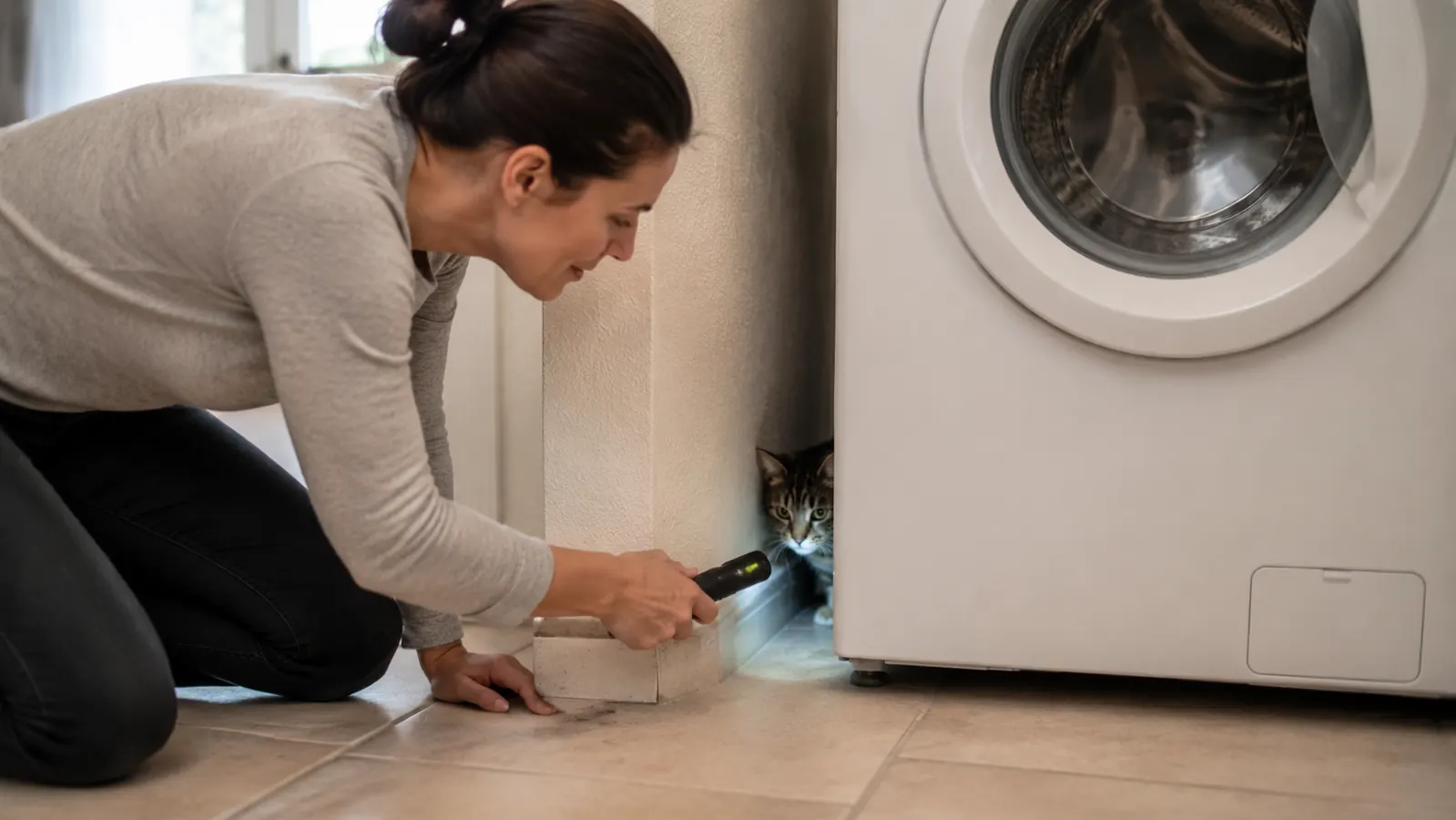
Start indoors. Many indoor cats do not actually escape outside when a door opens. They slip under a bed, behind the washer, or into a closet. The Tabcat signal works through walls and floors, so do a slow sweep of the rooms closest to where the door was left open before assuming your cat is outside. If the signal is weak or absent from indoors, move outside and begin sweeping the immediate perimeter of your home before widening the search.
If the signal is picking up but your cat is not visible, slow down further. A strong signal within a few feet means your cat is very close. Check under cars, behind bushes, inside any open boxes or containers in the area. When the beeping is at its fastest and the arrows are all pointing the same direction, stop and look carefully before you move. June was under a deck step, a gap I would never have thought to check, and the tracker took me straight to her in about four minutes.
What Else Helps: Combining the Tabcat with a Few Low-Tech Habits
The Tabcat handles active searching once your cat is missing. A few additional habits make it less likely you will need to search at all, and make the search easier when you do. Keep your cat's microchip information current with a national registry like the ASPCA or Found Animals. A collar tag with your phone number is still valuable because a neighbor who spots your cat may not have a chip reader but they do have a phone. Notify the two or three neighbors closest to you that your cat sometimes escapes and give them your number. Local Facebook or Nextdoor groups can extend a search in minutes if the tracker's range is not enough.
None of these replace the Tabcat, but they layer on top of it. The tracker finds your cat when they are hiding or close by. The social network finds your cat when someone else spots them a street or two away. The microchip reunites you with your cat when they end up at a shelter. The Tabcat V2 covers the most common scenario, which is a scared cat who has not gone far and needs to be found before night falls.
When a No-Subscription Tracker Is Enough
If your cat is indoors-only or ventures no further than your yard or the immediate neighborhood, tracking your cat without a monthly fee is a completely practical solution. The Tabcat V2 covers up to 122 meters in open air, which is a meaningful search radius in a suburban setting. It works through doors, walls, and floors. It does not require your phone, a cellular signal, or any ongoing account. You buy it once and it works.
Where a GPS subscription tracker makes more sense is for outdoor cats who roam freely across several city blocks or into wooded areas, or for owners who want to see their cat's real-time location on a map while at work. Those use cases are real and valid, but they represent a smaller portion of cat owners. If your situation is primarily an indoor cat who occasionally escapes, or an indoor-outdoor cat who stays within a couple of properties, the Tabcat approach delivers real peace of mind without a recurring charge.
I have linked to a deeper look at the Tabcat's performance in my full Tabcat cat tracker review, which covers range testing in real neighborhoods and how the homing signal behaves around metal fencing and concrete walls. If you are still weighing options, 10 reasons cat owners choose Tabcat over GPS subscriptions breaks down the practical tradeoffs without trying to talk you into anything.
Your cat does not care that you skipped the subscription. She just needs you to find her.
The Tabcat V2 includes two lightweight homing tags, a handheld directional receiver, and everything needed for setup. No monthly fee, no account, no cellular plan. Works indoors and out.
Amazon Check Today's Price on Amazon →