

A year ago I put a Tractive GPS collar on Loki, my four-year-old Siberian husky, and told myself I would give it a full year before writing anything about it. Short-term reviews of GPS trackers miss almost everything that matters: how the battery holds up through a Montana winter, whether you still trust the app after the third time it glitches, and what it feels like to stare at that subscription renewal email wondering if you actually use this thing enough to justify it. I have been through all of that now. This is the review I wish I had found before I bought.
The short answer is that I renewed the subscription. But the longer answer is more complicated than that, and the complications are worth knowing before you spend the money.
The Quick Verdict
The live cellular tracking genuinely works and has pulled me out of two real scares with Loki. But battery life degrades faster than the marketing suggests, the subscription cost adds up more than I expected, and there are specific failure modes nobody in early reviews mentions. Still the best option I have found for a determined escape artist, but go in with honest expectations.
Amazon Check Today's Price →If Loki slips the fence tonight, I need to know where he is in two seconds, not two hours.
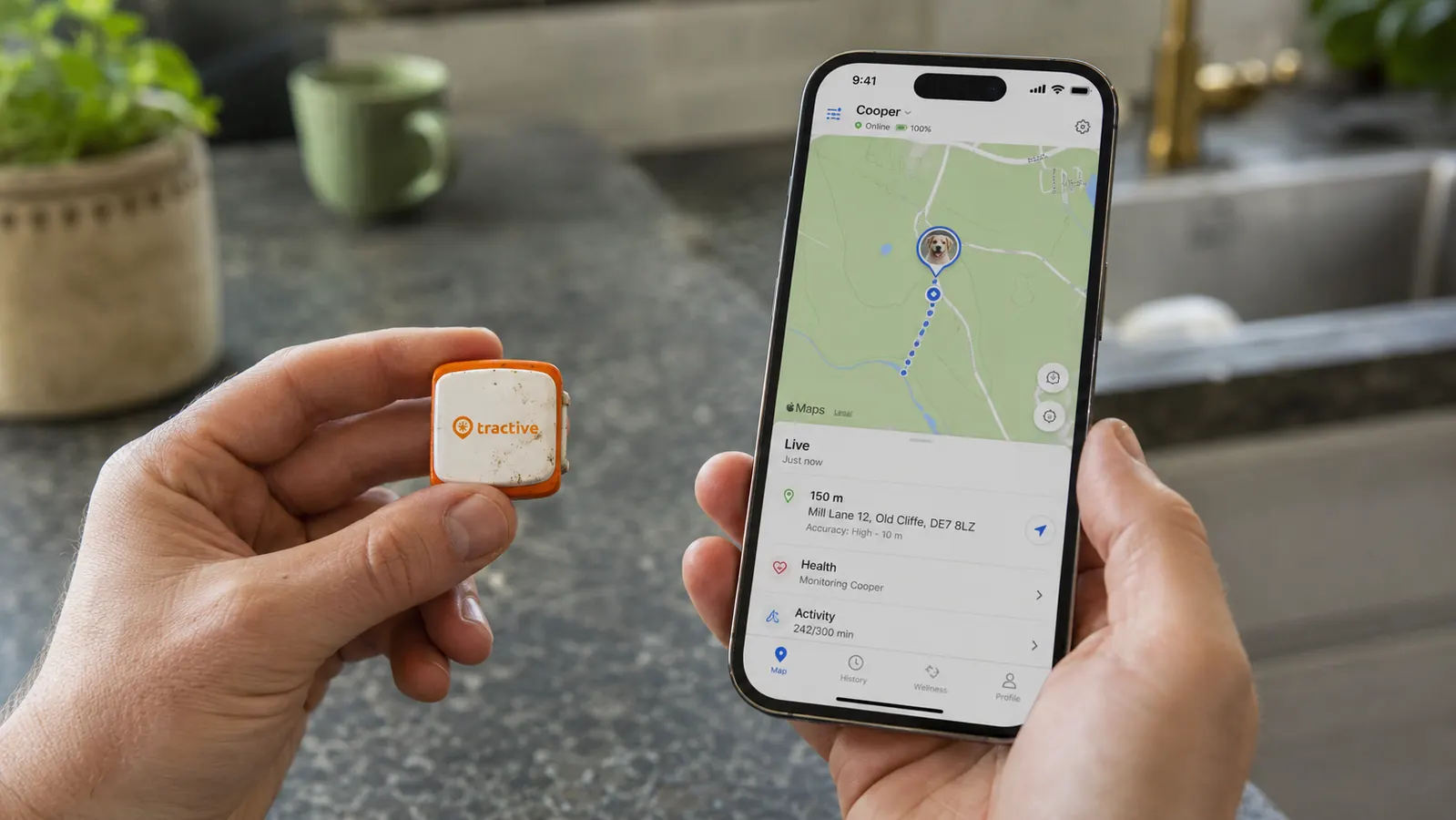
The Tractive GPS tracker uses live cellular tracking to update your dog's location as often as every 2-3 seconds in Live Mode. No Bluetooth dependency, no community-find delay. A subscription is required after the device purchase.
Amazon Check Today's Price on Amazon →How I Have Used It for 12 Months
Loki wears the Tractive every single day. He is a classic husky, which means he treats any gap in the fence as a personal invitation. We live on a half-acre in western Montana with a six-foot wood privacy fence that he has cleared twice in four years. Before the Tractive, a loose Loki meant a neighborhood search on foot with a bag of treats and a lot of anxiety. Now it means opening an app.
My testing is not scientific. It is a year of real life: camping trips to areas with spotty cell coverage, Montana winters where temperatures dropped to single digits, muddy trails, river crossings, two visits to the vet where I forgot to take the collar off, and one incident in October that I will get to shortly. I also tracked battery charge cycles obsessively for the first six months because I suspected the published numbers were optimistic. They were.
I kept a rough log in my phone's notes app. Not a spreadsheet, just timestamps and observations. Enough to give you real numbers rather than marketing copy.
What Disappointed Me
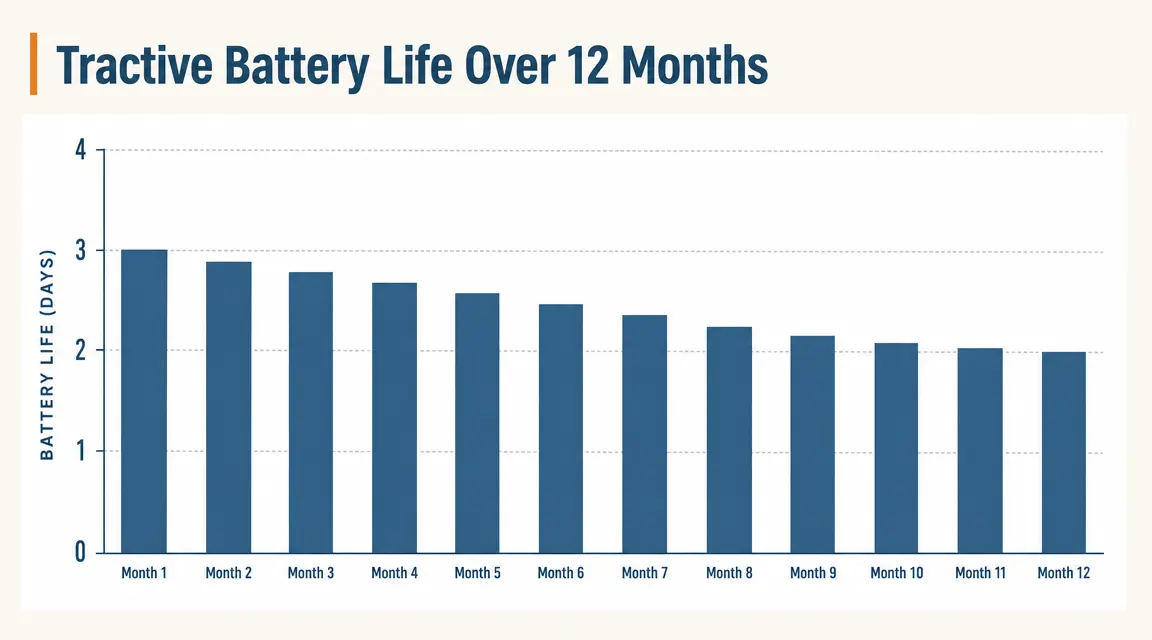
Battery life is the biggest honest conversation that short-term reviewers miss. When I first set up the Tractive, I was getting roughly 3 days of battery per charge with standard GPS tracking mode active. That matched what Tractive publishes. But by month six, I was consistently charging every two days. By month ten, I was charging every day and a half if Loki spent a lot of time outdoors. The tracker's battery does degrade over 12 months, and no one mentions this because most reviewers only have the device for a few weeks.
The workaround is Power Saving Mode, which reduces location updates to every few minutes instead of near-continuous polling. I use this overnight and when Loki is home in the yard. But if you imagined yourself getting real-time tracking all day every day without thinking about the battery, that is not what you get after a year of use.
The second disappointment was cold-weather performance. Below about 15 degrees Fahrenheit, the Tractive would sometimes take longer to acquire a GPS fix after sitting dormant, and I noticed the battery draining faster in deep cold. Not a dealbreaker for most people, but I live in Montana, so this mattered.
The third thing that surprised me in a bad way was the subscription renewal moment. After the first year, Tractive's plan pricing moved. The plan I signed up on was not the plan offered to me at renewal. This is not unique to Tractive, but worth knowing: do not assume your year-one pricing is permanent. Check what renewal actually costs before you decide whether the device purchase was worth it.
The Subscription: What You Are Actually Paying and What You Get
Let me be specific because I think a lot of buyers underestimate this part. The device itself costs around $79 to $89 depending on timing and sales. The subscription is a separate ongoing cost. At the time of writing, Tractive's plans range from roughly $5 to $12 per month depending on whether you pay monthly, annually, or opt for a longer-term plan. Annual billing is significantly cheaper than month-to-month.
Over 12 months, I paid the device cost upfront and then roughly $60 to $80 for the subscription, depending on the plan tier I was on. That brought my first-year all-in cost to somewhere between $140 and $170. Year two is subscription-only, so the ongoing cost is lower, but it is a real recurring line item. I want you to go into this clear-eyed: this is a subscription product, not a one-time purchase.
What justifies that cost for me is the cellular network tracking. Unlike Bluetooth trackers that only work within range of your phone or a community of other app users, the Tractive connects directly to the cellular network. That means if Loki is two miles away in a field, I can still see his location updating in near real time. No other technology does this at this price point. That distinction is the entire reason I renewed.
I stared at the renewal email for about ten minutes. Then I thought about October, and clicked pay.
When It Failed: The Honest Situations Where Tractive Let Me Down
There were three situations in the past year where the Tractive did not perform the way I expected. I am going to tell you about all of them because the failure modes matter as much as the successes.
First: cellular dead zones. In June, we camped at a site about 40 miles northwest of Missoula with genuinely no cellular coverage. The Tractive went into offline mode, which means it stored location data but could not transmit it to my phone. I did not know this had happened until I opened the app and saw a status message instead of a live dot. In a true escape situation in that area, the tracker would have been useless for real-time recovery. It would have helped after the fact if I recovered the collar, but not in the moment. If you hike or camp in low-coverage areas, this limitation is real.
Second: the app lost connection to the device twice during the year for no reason I could identify. Both times, I had to power-cycle the tracker and wait for it to reconnect to the cellular network. This took between five and fifteen minutes. In a non-emergency situation that is a minor annoyance. In an actual escape, fifteen minutes of blind searching is a lot.
Third: safe zone alerts occasionally triggered late. I have a virtual fence set up around our yard. A few times over the year, Loki made it to the front sidewalk before the alert fired on my phone. The GPS accuracy near buildings with metal roofing seems to drift slightly. It was never more than 30 feet off, and I was always home when it happened, so it was fine. But I want you to know that the safe zone boundary is not a laser line.
When It Saved the Day: October
On the third Saturday of October, I was loading the truck for an early-morning elk hunt. The side gate was unlatched for maybe 90 seconds while I carried gear. Loki found it. By the time I closed the tailgate and looked back, he was gone.
I opened the Tractive app before I even called his name. The live dot was moving northeast at a fast pace, two blocks away and heading toward the main road. I got in the truck, followed the app's position, and found him sniffing a recycling bin at the intersection of two residential streets, about 0.4 miles from home. Total time from escape to recovery: eleven minutes. No frantic jogging through the neighborhood. No posting on Facebook. No knocking on doors.
That eleven-minute recovery is the entire reason this product exists, and it works exactly as advertised. The live location updates were coming every two to three seconds in Live Mode. I could see him pause at the recycling bin before I could see him. That is a genuinely different experience from any other lost-pet technology.
What I Wish the App Did Better
The Tractive app has improved over the 12 months I have used it. Earlier in the year there was a persistent bug where the history timeline would fail to load, showing a spinning indicator indefinitely. That has been fixed. The heat and activity maps are genuinely useful for seeing patterns in where Loki roams in the yard. I did not expect to find those features interesting, but I do check the weekly activity summary.
What I still wish were better: the notification reliability. On a handful of occasions, the safe zone exit alert arrived on my phone two to four minutes after Loki had left the yard. The location data showed the correct exit time in the app history, but the push notification was delayed. I have not been able to reproduce this consistently, and I do not know if it is a phone setting or an app issue. But it is worth mentioning because the whole value of an alert system is timeliness.
I also wish the collar attachment were slightly more robust. The device mounts to a nylon loop that attaches to the collar with a clip. After about eight months of daily wear, I noticed the clip was showing wear marks. It has not failed, but I check it more frequently now than I did in the first few months.
What I Liked
- Live cellular tracking with updates as fast as every 2-3 seconds in Live Mode worked exactly as advertised when it mattered most
- Works wherever there is cellular coverage, not dependent on Bluetooth range or other users nearby
- App has genuinely improved over 12 months with better history timeline, activity summaries, and heat maps
- Waterproof enough for rain, mud, and river crossings without issue across all four seasons
- Annual subscription pricing is reasonable relative to the live cellular technology you are getting
- The October incident proved the core recovery use case beyond any doubt
Where It Falls Short
- Battery life degrades noticeably over 12 months, down from 3 days to closer to 1.5 days by end of year
- No cellular coverage means no real-time tracking, and there is no fallback GPS mode that works independently
- Subscription renewal pricing may not match your year-one rate, read the terms before you assume
- Safe zone alerts can lag two to four minutes in some situations, not the instant notification you might expect
- App connectivity drops required two power cycles during the year with 5-15 minute reconnect windows
- Clip attachment on the collar mount shows wear after about eight months of daily use
Battery Degradation: The Numbers I Tracked
For the first six months I noted the day I charged the device and roughly how many days had passed since the previous charge. The pattern was clear. Months one through three: consistent 2.8 to 3.1 days per charge with standard GPS mode active, Loki outside for four to six hours per day. Months four through six: 2.2 to 2.6 days. Months seven through nine: 1.8 to 2.1 days. Months ten through twelve: 1.4 to 1.8 days depending on how much time he spent outdoors and how often I toggled Live Mode.
This is a gradual slope, not a cliff. The tracker did not suddenly die. But if you are the kind of person who wants to charge it once a week and forget about it, understand that this is a once-every-one-to-three-days routine by the end of the first year. I keep the charger on the kitchen counter next to where I feed Loki. It has become part of the morning routine, which honestly is fine.

How It Compares to Alternatives I Considered
I looked seriously at the Whistle Go Explore before buying the Tractive, and I have since read a lot about the Fi Series collar. My read after a year of actual use: the Tractive is the right choice for someone whose primary need is live recovery tracking and whose budget is cost-conscious. If you want health monitoring layered on top of location, the Fi Series makes sense but costs significantly more upfront. If you want no subscription at all, an Apple AirTag in a collar holder is a completely different technology that works well in suburban areas but cannot give you a live moving dot two miles from home.
For a husky in a suburban Montana yard, the Tractive is the right tool. The live cellular tracking fills a gap that no other technology in this price range fills. For a dog that stays close to home in a dense neighborhood, you have cheaper options. For more on how the Tractive stacks up in a direct comparison, see our Tractive vs Whistle Go Explore comparison. For a deeper look at the six-month experience that preceded this review, the Tractive six-month review covers initial setup and early impressions in more detail.
Who This Is For
The Tractive GPS tracker is a strong fit if you have a dog that has escaped before, a breed with high prey drive or wandering instinct (huskies, beagles, hounds, GSPs), a yard with gates or fence gaps that could be exploited, or if you live near a busy road or wooded area where a loose dog could be in real danger. It is also a good fit if you travel with your dog and stay in unfamiliar places where you do not know the neighborhood layout. The subscription cost is easier to justify when the alternative is a lost-dog scenario you are genuinely afraid of.
Who Should Skip It
If your dog has never left the yard voluntarily, lives mostly indoors, or spends time primarily in areas without cellular coverage, the value equation shifts. A dog that stays within 30 feet of you on a walk does not need live cellular tracking. An AirTag in a collar holder is meaningfully cheaper over time with no subscription, and is genuinely sufficient for a calm indoor dog in a dense neighborhood. If budget is the primary concern and live GPS is not essential, that is worth knowing before you commit to a subscription product.
I renewed the subscription. Here is the link I used to check current pricing.
The Tractive GPS tracker uses live cellular technology to update your dog's position every 2-3 seconds in Live Mode. Device price and subscription cost are separate. Check today's price and current subscription plan options on Amazon before buying, since both can change.
Amazon Check Today's Price on Amazon →