
I want to tell you something before you buy an AirTag for your dog: it is not a GPS tracker. I know the product listing does not always make that obvious. I know the Amazon search results for 'pet tracker' are full of them. And I know they are cheap relative to a Tractive or a Fi collar. But if you walk away from this review understanding one thing, let it be that distinction, because it changes everything about when an AirTag makes sense and when it absolutely does not.
I put three dogs through six months of AirTag testing for this review: Milo, a 14-pound terrier mix who rarely leaves the yard; Pepper, a 47-pound border collie mix who would escape a maximum security facility if given half a chance; and my own husky, Loki, who has run off exactly twice in four years but both times aged me considerably. None of them knew they were test subjects. All three wore AirTag holders on their collars starting last October. Here is what I found.
The Quick Verdict
A smart secondary tracker for iPhone households in dense suburban or urban areas, a poor choice as a sole tracker for active escape artists or Android families, and completely inappropriate for rural environments where the Find My crowd is thin.
Amazon Check Today's Price →Your dog slipped out three minutes ago. Do you know where she is right now?
AirTag works best when the neighborhood is full of iPhones. Check today's price on the 4-pack, and read on to find out whether your situation matches what AirTag actually does well.
Amazon Check Today's Price on Amazon →How I Tested: Six Months, Three Dogs, Different Environments
Testing started in October and ran through March, which gave me both dense suburban foot traffic and the quieter winter months when fewer people are walking around with iPhones in their pockets. I attached one AirTag to each dog using a third-party silicone loop holder from Amazon. I also carried Tile and Tractive trackers on Pepper during parallel weeks so I could compare the find-speed and coverage honestly.
I ran three categories of tests: controlled range tests (me walking away from my phone while the dog stayed put), real-world slips (Pepper actually escaped twice; I timed how long until I got a location ping), and indoor hide tests (hiding the dog in a room with Precision Finding active). I did not just sit at a desk and read the spec sheet. These are real numbers from real situations.
One thing I want to flag before we get into specifics: I am an iPhone household. My partner has an iPhone. Three of my neighbors have iPhones I can see pinging regularly in the Find My network. That matters enormously, and I will explain why shortly.
What AirTag Actually Is: Bluetooth Plus a Borrowed Network
The AirTag does not have a cellular chip. It does not have GPS. What it has is a Bluetooth Low Energy radio that speaks to nearby iPhones, which then anonymously and silently report the tag's location to Apple's Find My network. Your phone sees that report and shows you a dot on a map. The location you see is wherever the last iPhone that walked past your dog happened to be standing.
This works remarkably well in the right conditions. In my neighborhood, which has maybe 60 houses within a quarter mile and a good mix of iPhone users, Pepper's location updated every few minutes when she was in the front yard. When she actually got out in November, I had a location ping within about four minutes. That was good enough to drive toward her and use Precision Finding (the UWB direction arrow that appears when you are within Bluetooth range) to find her behind someone's shed about two blocks away.
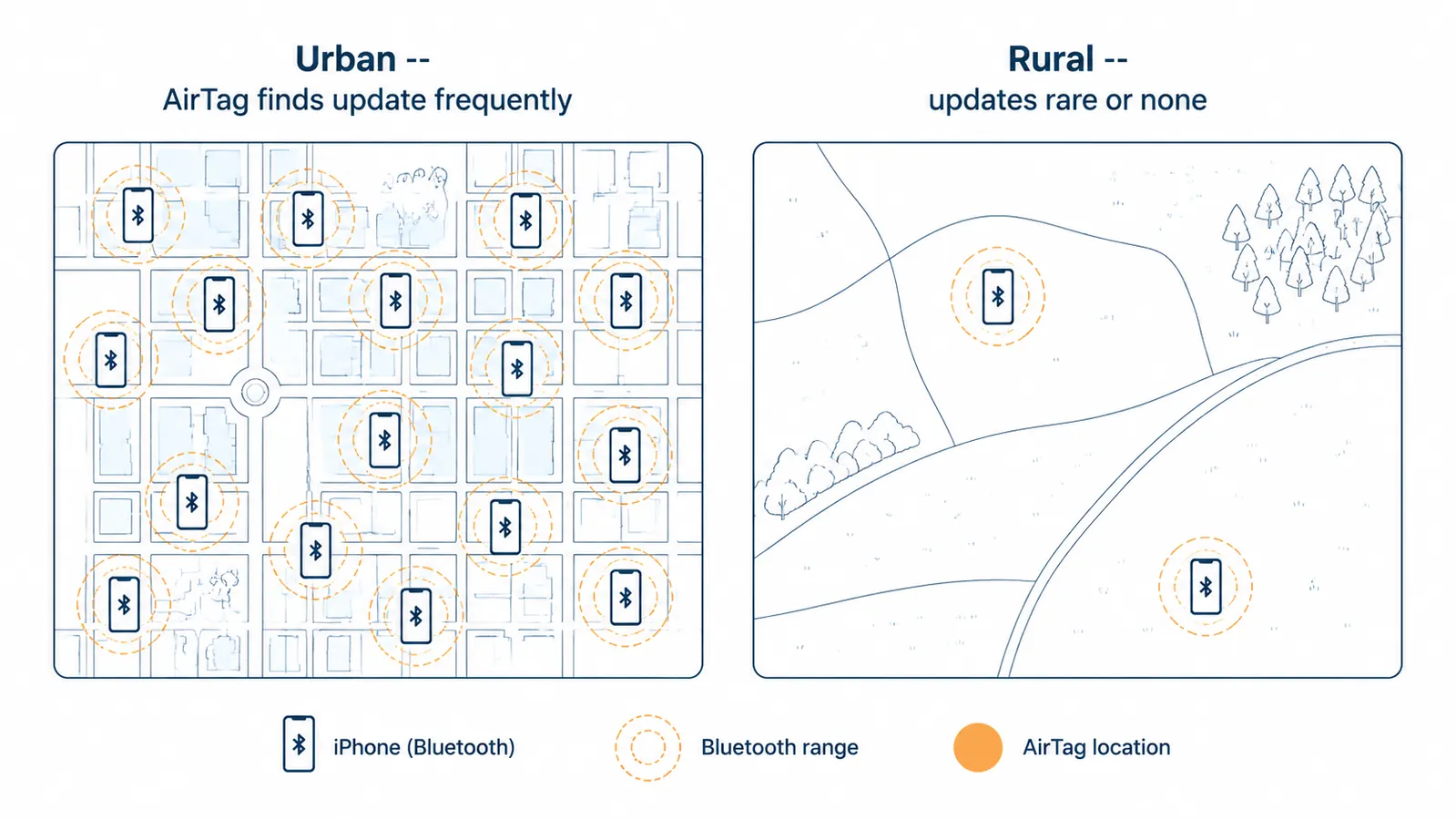
But here is the thing nobody in the affiliate roundup posts tells you: that four-minute update depends entirely on another iPhone walking near your dog. If your dog runs to a park with no iPhone users at 6 a.m. on a Tuesday, you may wait 20 minutes or more for the first ping. If she runs into a field or a forest, you may get nothing until she happens back toward civilization. The AirTag is not tracking her. It is waiting for someone else's phone to notice her.
Urban vs Rural: Why Your Zip Code Determines Whether This Works
I drove Loki out to a rural property about 40 miles from my house to run this test deliberately. We are talking maybe two houses per quarter mile, older demographic, probably half the residents on Android. I walked him 300 yards from my car and then walked back. My phone showed his last known location as the parking area where we started. It took 22 minutes before the location updated, and only because a truck drove down the adjacent road.
Compare that to the urban test I ran in a downtown area two miles from my house. Milo's location updated six times in under three minutes while I walked him around a busy block. The network density in a walkable city neighborhood is almost as good as real-time. In a rural area, it is essentially useless as an emergency finder. You need to already be walking toward your dog with your phone out for Precision Finding to activate.
This is not a flaw in the AirTag specifically. It is the honest truth about every crowd-sourced Bluetooth tracker, including Tile and Samsung SmartTag. The Find My network is Apple's advantage here because iPhone penetration in the US is over 55 percent and climbing, but that still means nearly half of all phones nearby cannot help you. In suburban and dense urban areas, iPhone density is even higher. In rural areas, older demographic neighborhoods, or regions with lower iPhone adoption, the math works against you.
The Anti-Stalking Alert: What Pet Owners Need to Know
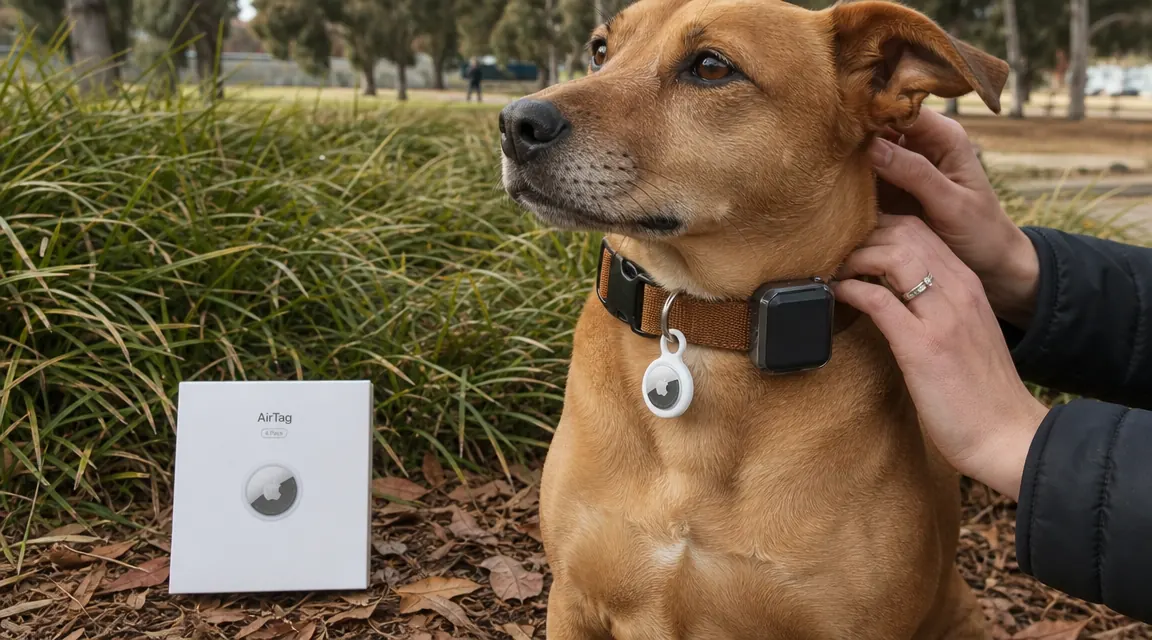
Apple built AirTag with an anti-stalking feature that every pet owner needs to understand before they hand one to their dog-sitter or neighbor. If an AirTag is traveling with someone who does not own it and they have an iPhone, their phone will eventually notify them that an unknown AirTag has been traveling with them. The alert window is variable but can trigger in as little as a few hours.
If your dog stays at a friend's house overnight and that friend has an iPhone, they may receive an 'AirTag Found Moving With You' notification. Most people who know why it is there will ignore it. But it can cause confusion or alarm if they do not know your dog is wearing a tracker. The practical fix is simple: tell anyone who watches your dog that the collar has an AirTag on it. But you do need to tell them, because the alert is real and it will trigger.
Android users will not receive any alert at all. Apple released a companion Android app that can detect AirTags, but it requires actively scanning. This is relevant if you are trying to use an AirTag to monitor a dog being transported or boarded, because Android-only households have no passive protection against this.
The Android Dealbreaker: If Half Your House Uses Android, Stop Here
AirTag works only with Apple's Find My. That means you need an iPhone running iOS 14.5 or later to see your dog's location, use Precision Finding, or receive lost alerts. If you or your partner has an Android phone, they cannot access Find My at all. There is no Android AirTag app for tracking your own items.
This rules out the AirTag entirely for Android households. If your partner is the one who walks the dog and they have a Pixel or Galaxy, they will have zero ability to find the dog using the AirTag if something goes wrong on their watch. A Tile tracker has Android support. A Tractive or Whistle GPS collar has both iOS and Android apps. For mixed households, the AirTag is not a viable sole tracker.
The AirTag is not tracking your dog. It is waiting for someone else's iPhone to walk by and notice her. In a busy neighborhood, that works. In a field at dawn, it does not.
Battery Reality: One Year Life Is Real, but Replacement Has a Catch
Apple advertises about one year of battery life on the CR2032 coin battery inside the AirTag, and in my testing across six months, none of my three AirTags have shown a low battery warning yet. That is a genuine advantage over cellular GPS trackers, which typically need charging every two to seven days. Milo the terrier's AirTag has never been off his collar for charging.
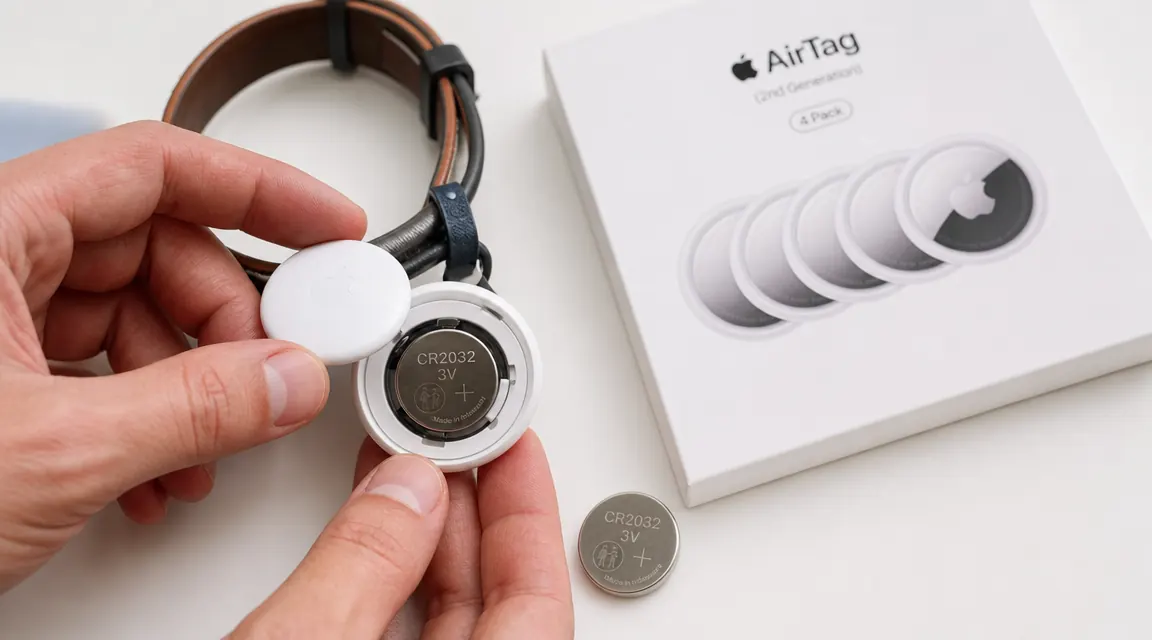
When the battery does die, replacement is easy. You twist the back cover counterclockwise, pop it off, swap the battery, and twist it back on. CR2032 batteries are a few dollars for a pack of five at any drugstore. No subscription, no dock, no cable. For dogs who hate wearing a collar that comes off every few days, this alone is a meaningful quality-of-life improvement.
One caution: Apple added a requirement in late 2023 that the CR2032 must not have a bitter coating (some child-safety batteries use bitterant additives to discourage ingestion). Standard CR2032 batteries work fine. Bitterant-coated ones may not be recognized by the AirTag. Check the packaging before buying replacement batteries.
Collar Attachment: AirTag Was Not Designed for Dogs, but It Works
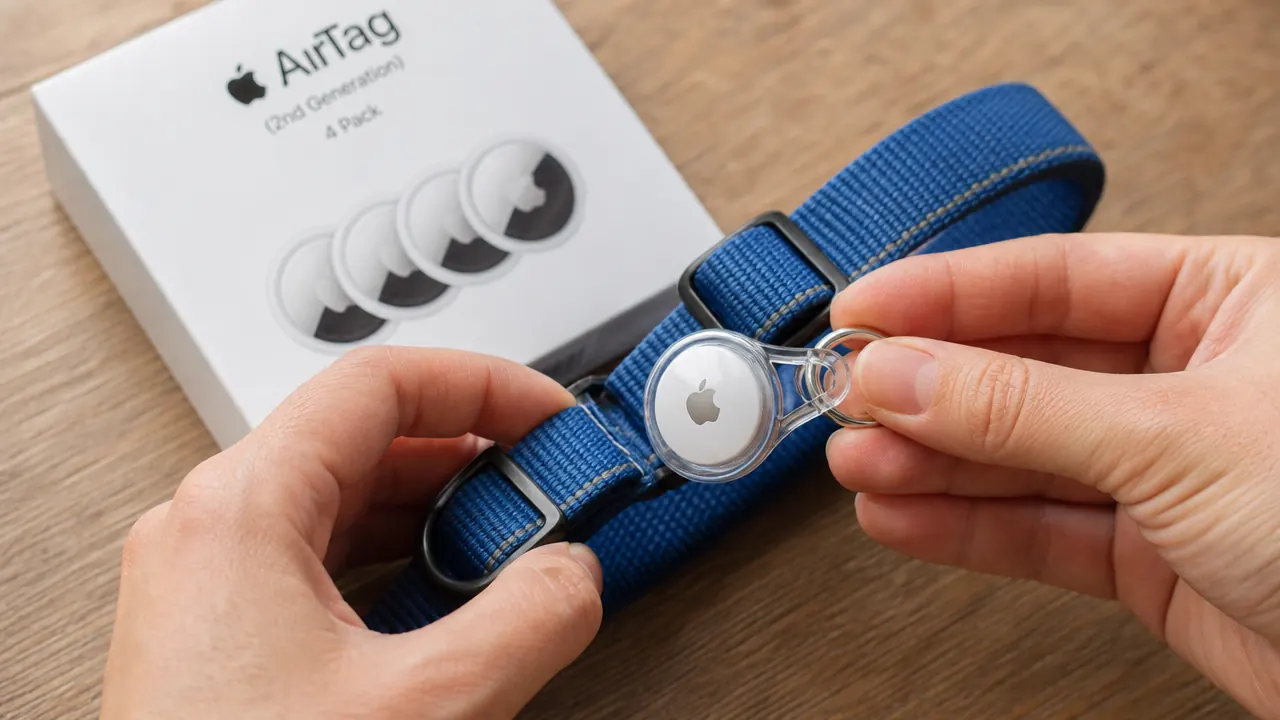
The AirTag itself is a smooth white disc about the size of a large button. Apple sells its own holder loop for it, but the official loop is leather and not waterproof. For a dog, you want something that can get wet without deteriorating. Most AirTag users on dogs end up with a third-party silicone case or a polycarbonate shell that threads onto the collar. Both work well. I used a no-name silicone loop from Amazon for all three dogs and none of them lost a tag in six months.
Weight is worth mentioning for small dogs. The AirTag itself weighs 11 grams, and most silicone holders add another 5 to 10 grams. That puts the total around 20 grams, which is fine for a 14-pound terrier and invisible to a 60-pound dog. If you have a cat or a very small dog under 10 pounds, the weight becomes more significant, though I know cat owners who have used it successfully. The AirTag is IP67 rated, meaning it handles submersion in up to one meter of water for 30 minutes. Dogs who swim, wade, or play in sprinklers are covered.
What I Liked
- No monthly subscription fee, ever
- Battery lasts roughly one year on a cheap CR2032 coin cell
- IP67 waterproof rating handles swimming and rain
- Precision Finding (UWB direction arrow) is genuinely excellent once you are close enough to trigger it
- Find My network density in suburban and urban US neighborhoods is solid
- 4-pack price makes covering multiple pets affordable
- Works with Separation Alerts to notify you when your pet leaves a known location
Where It Falls Short
- Not GPS, not cellular; location depends entirely on nearby iPhones
- Rural and low-density areas may see updates 20-plus minutes apart or not at all
- iPhone-only ecosystem is a hard stop for Android households
- Anti-stalking alerts can confuse pet sitters or neighbors who do not know about the tag
- No real-time tracking in any environment; updates are crowd-sourced and asynchronous
- No activity monitoring, no health data, no virtual safe-zone geofencing alerts
- Apple's own collar attachment is leather and not waterproof; requires a third-party holder for dogs
Who This Is For
The AirTag is genuinely a smart choice in three specific situations. First, indoor cats who occasionally slip outside. If your cat bolts out of the front door and hides under a car on your street, a quick Precision Finding session will locate her in minutes. The tight range limitation actually works in your favor here because she is almost certainly within a few hundred yards. Second, urban or dense suburban dogs who could escape a yard but are unlikely to travel more than a mile before someone's iPhone picks them up. Third, it works well as a secondary tracker on a dog who already wears a cellular GPS collar. The AirTag costs nothing monthly and adds a backup that survives GPS gaps, keeps working even if the collar subscription lapses, and gives you a Precision Finding mode when you are close enough to triangulate.
If you live in a dense iPhone neighborhood, keep all your dogs in a fenced yard, and have never had an escape artist, the AirTag 4-pack at today's price is probably the most cost-effective tracking backup you can buy. One tag per dog, one for a cat, and one spare. The math works.
Who Should Skip It
If you own a runner breed such as a husky, a beagle, a greyhound, or a hunting hound, the AirTag is not the right primary tracker. These dogs can cover a mile in minutes. A half-mile of open space with sparse iPhone users and your last known location is an arrow pointing at a field corner where your dog was eight minutes ago. That is not actionable. You need a cellular GPS tracker that pushes the dog's live location to you every two to six seconds, regardless of who happens to be nearby.
Skip AirTag if your household has Android users who need tracking access. Skip it if you live in a rural area or take your dog camping, hiking, or hunting. Skip it if you want safe-zone alerts that fire the moment your dog crosses a fence line. And absolutely skip it as your only tracker if your dog has ever gone more than a quarter mile in an escape. The downside of not knowing where she is in time is too real to accept those odds.
For those situations, a cellular GPS tracker with a monthly plan is a real cost, but it is also a real capability. You get live location updates every few seconds, coverage anywhere your carrier reaches, and notifications the moment your dog leaves a defined zone. The AirTag cannot do any of that. No Bluetooth tracker can. That is not a knock on Apple; it is just physics and infrastructure.
AirTag makes sense for your situation? Here is today's price on the 4-pack.
The 2nd Generation AirTag 4-pack comes in at a low per-tag cost with no ongoing fees. It is the right call for iPhone households in suburban areas who want a lightweight backup tracker for indoor cats and yard dogs. Check today's price and availability below.
Amazon Check Today's Price on Amazon →