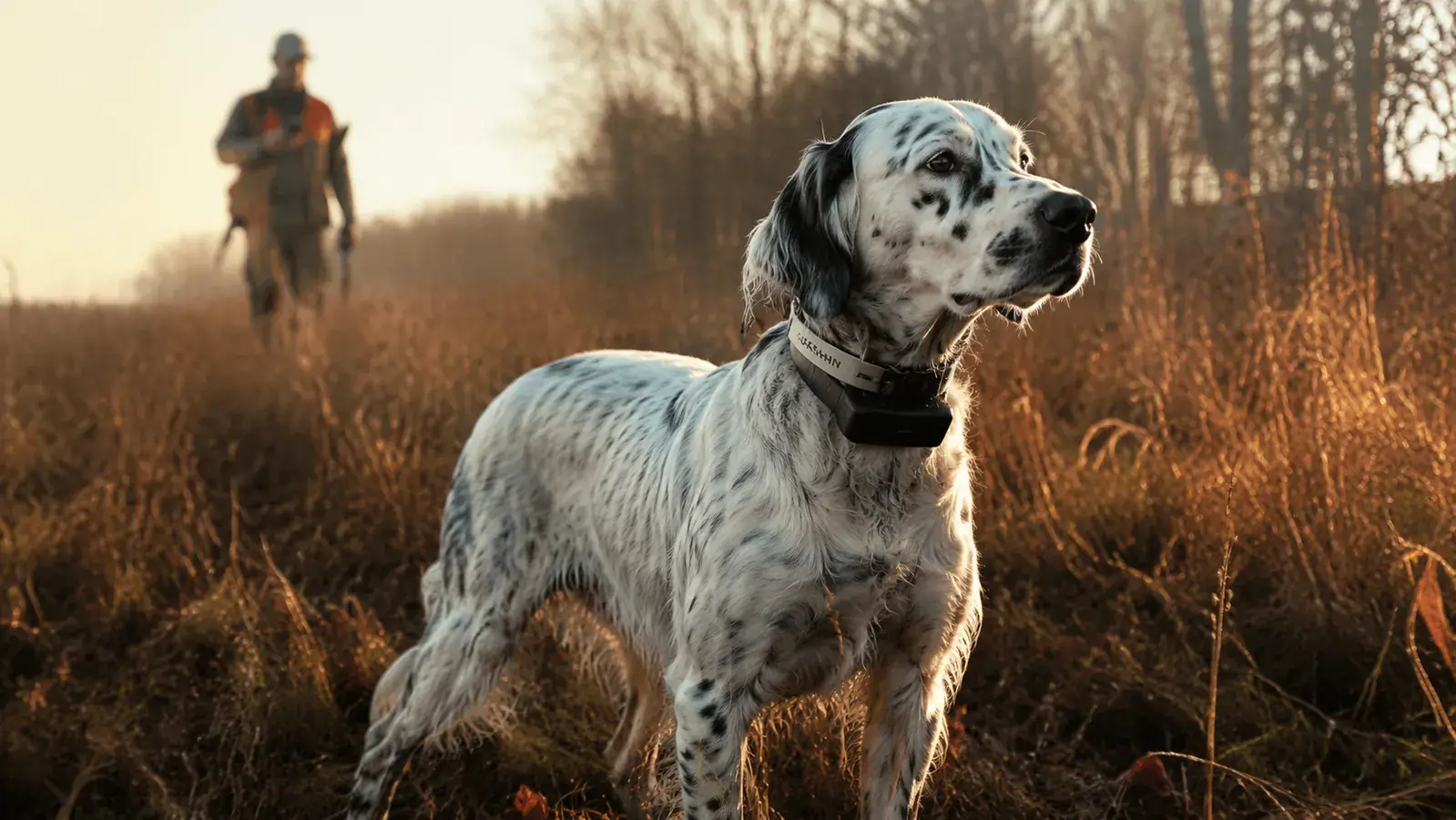
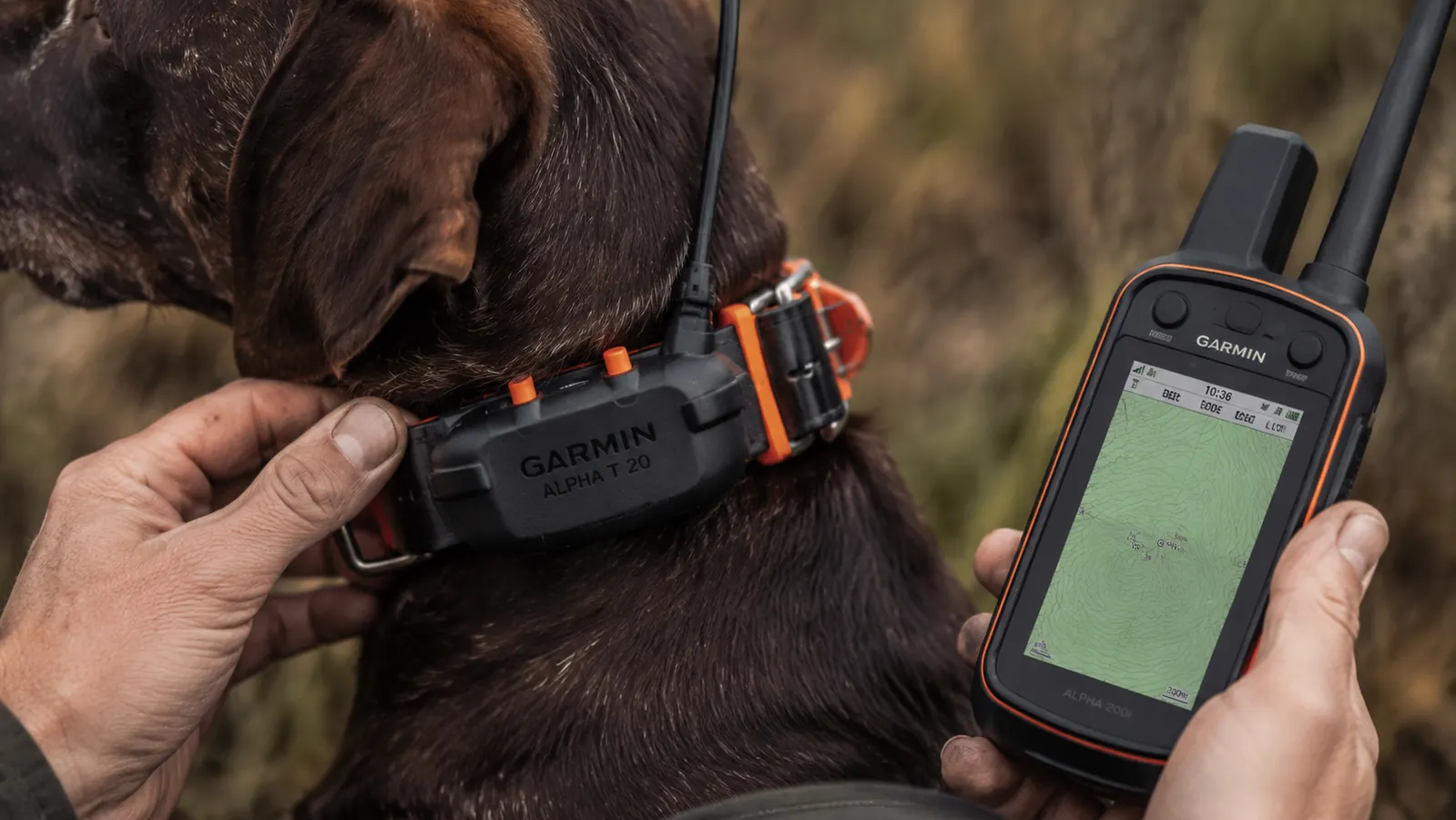
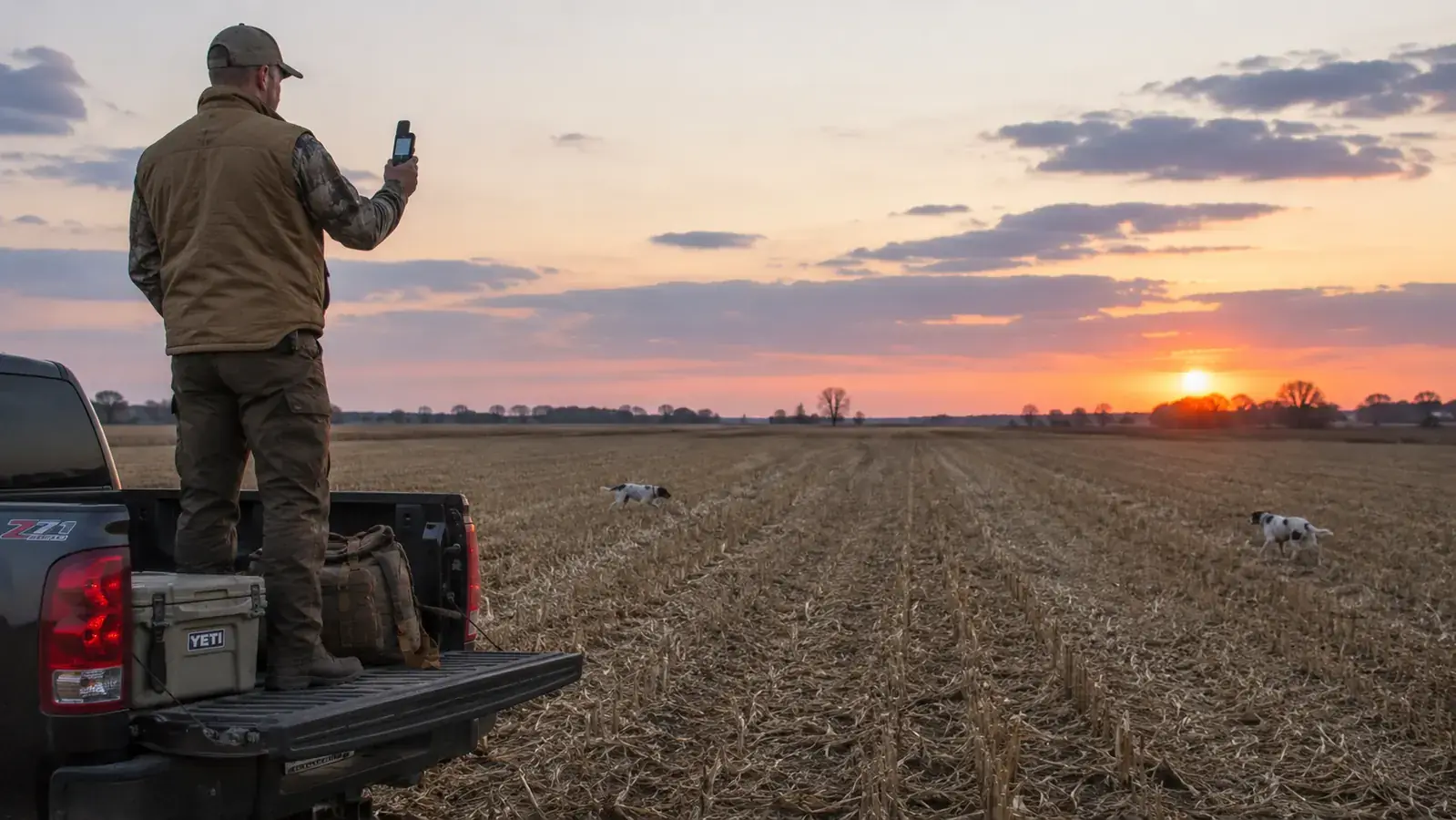
My setter Dora ran a full 600 yards into a creek bottom last November and disappeared into a wall of cottonwoods so thick you could not see five feet into it. No whistle was bringing her back. No amount of calling was going to cut through that brush. What I did have was the Alpha T 20 collar on her neck and the Alpha 200i handheld in my vest. I watched her icon on screen, waited until she went on point, and walked a straight line right to her. She had pinned a rooster pheasant against the far bank. That was season three. I have run this system through three full hunting seasons now, on two dogs, across four states, and I want to give you the review that nobody who just unboxed the thing can write.
The review_a article on this site covers long-term setup and daily use. This one is different. This is the field test: what breaks, what surprises you, what the spec sheet lies about by omission, and the honest answer to whether $300 for the collar alone is justifiable when the handheld controller costs extra. I am going to be direct. There are real limitations here that you should know before you buy.
The Quick Verdict
The best off-grid hunting dog GPS collar available at this price, but the full system costs more than Garmin advertises and the learning curve is real. Worth every dollar if you hunt in places where your phone has no signal.
Amazon Check Today's Price →Your dog is faster than the woods are forgiving. Get the system that works where your phone doesn't.
The Garmin Alpha T 20 collar pairs with the Alpha 200i handheld for direct-radio GPS tracking with no cellular signal required. Check today's price on Amazon before the next season starts.
Amazon Check Today's Price on Amazon →How I've Used It and What the Test Actually Looked Like
Dora is a five-year-old English Setter, 48 pounds, bred for big-running field trial work. My second dog, Pete, is a three-year-old Setter, 52 pounds, more of a close-working grouse dog. I have hunted them both with the Alpha T 20 collars since the system launched. The three seasons cover wild quail in Kansas, pheasant in South Dakota, and grouse in northern Minnesota. Terrain ranges from open short-grass prairie with sightlines of a mile or more, to dense creek-bottom cottonwood and willow, to the tag alder and birch thickets that define grouse country. If you want to stress-test a GPS collar, that rotation will do it.
I tracked usage in a simple notebook: how many tracking sessions per day, any signal loss events, battery state at end of day, and any hardware issues. Three seasons means roughly 45 hunting days per season, 135 days total across two collars. The data is not scientific but it is more than most reviewers accumulate before writing a verdict.
Before I get into performance, I need to address the cost picture honestly, because this is the thing that most product pages gloss over completely.
The Real System Cost: What Nobody Tells You Before You Buy
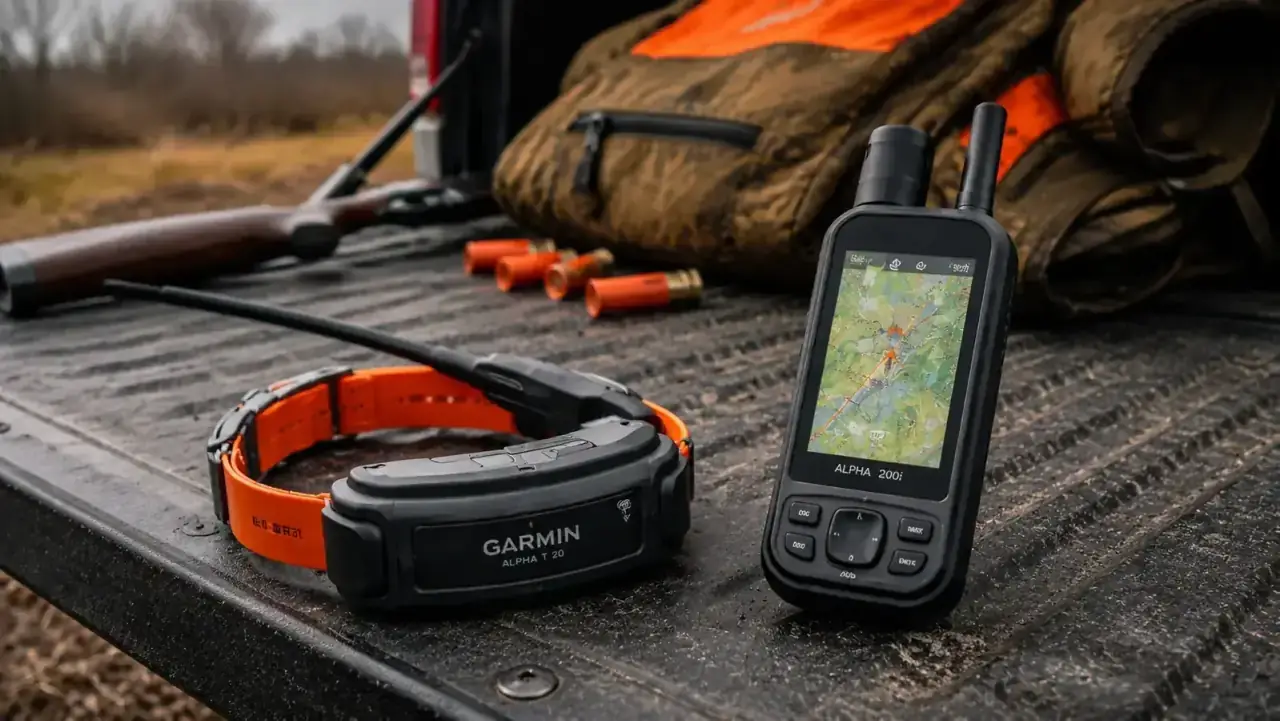
The Garmin Alpha T 20 is the collar only. It is not a standalone product. It requires a compatible Garmin Alpha handheld controller to function. The Alpha 200i is the current pairing unit and it sells separately. When you add the handheld to the collar, you are looking at a total system investment that is substantially higher than the collar price alone. If you run two dogs, you need two collars. The handheld pairs with up to 20 dogs, so you only buy one of those, but the second collar is another full collar cost. That is the honest math, and I wish someone had laid it out clearly before I ordered.
The upside of this architecture is that there is no monthly subscription. No cellular plan, no renewal date, no outage if the network goes down. Once you own the hardware, you own it. For serious hunters who run multiple seasons per year, the total cost of ownership over three years compares favorably to any cellular subscription tracker. But you need to budget for the full system on day one, not just the collar price you saw on Amazon.
Cellular trackers from brands like Tractive or Whistle are cheaper to enter and easier to set up. They work fine in your backyard, in suburban parks, and anywhere your phone has LTE coverage. They fail completely in the places hunters actually need them: national forests, river bottoms, prairie with no tower for 30 miles. I switched after losing a dog for two hours on public land in Kansas because my cellular tracker showed the last known location from when the dog left cell coverage. That is a different problem than what the Alpha T 20 solves.
The cellular tracker showed his last known location from when he left coverage. That is a fundamentally different problem than having no tracker at all. With the Alpha T 20, I have never had that moment again.
What 9-Mile Range Actually Means in the Field
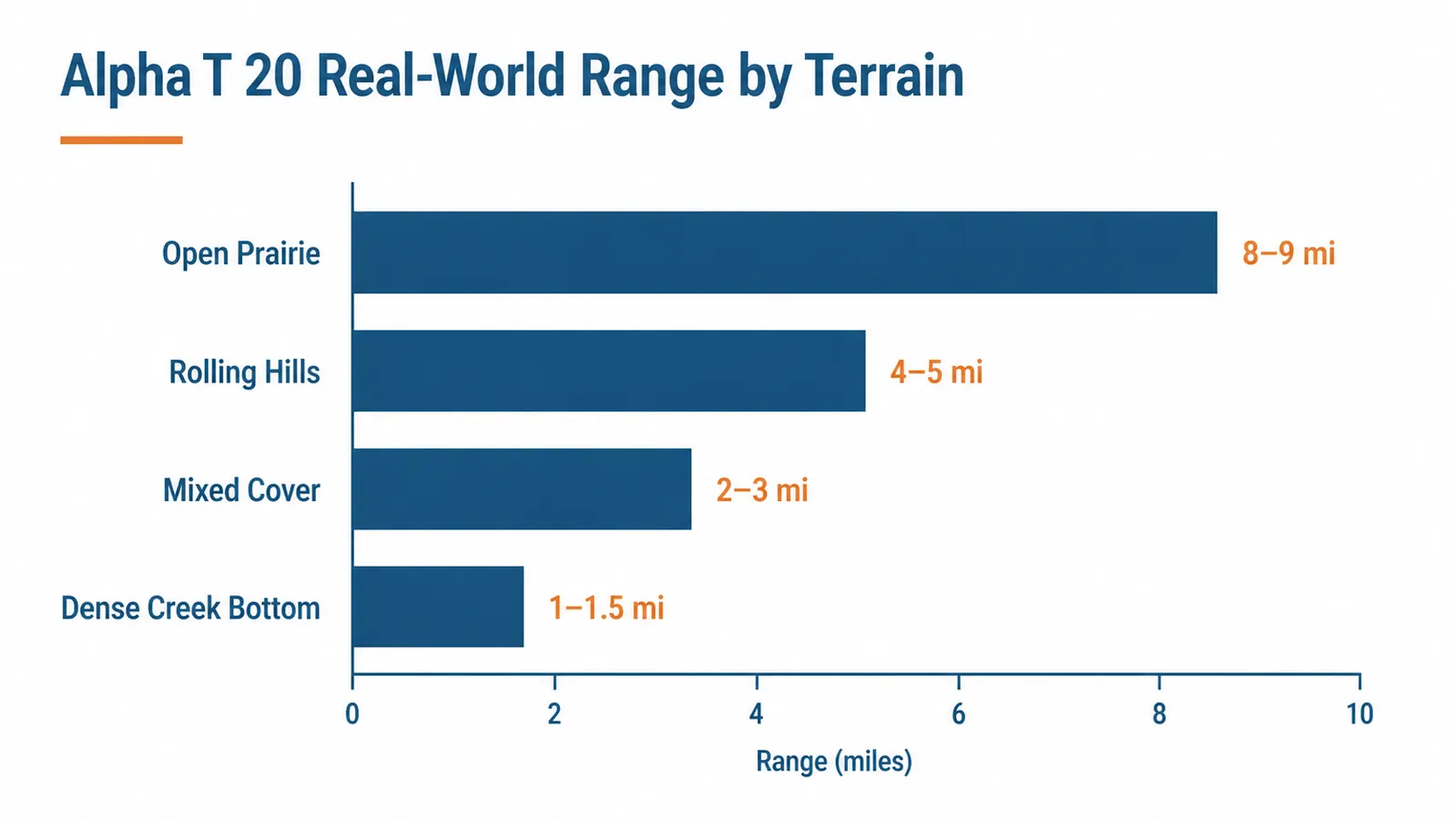
Garmin rates the Alpha T 20 at up to 9 miles of range. That number is real and I believe it. I have also never achieved it in a hunting scenario, and neither will you, and that is fine once you understand what the number means.
The 9-mile figure is line-of-sight, measured in controlled conditions, likely on a flat open plane with elevated antenna orientation. In open short-grass Kansas prairie with good elevation, I have reliably tracked Dora at 4 to 5 miles with no signal interruption. That is extraordinary. No cellular tracker comes close to that, and it is genuinely enough range that I have never lost a dog on open ground in three seasons. In rolling hills with alternating draws and ridges, effective range drops to 2 to 3 miles, which still covers nearly any hunting scenario. In dense creek-bottom timber or the kind of northern Minnesota alder that blocks even radio waves, expect 1 to 1.5 miles on a good day.
The key lesson: range is a terrain variable, not a fixed specification. The good news is that 1 to 1.5 miles in heavy timber is still better than zero, which is what cellular gives you in those areas. If your hunting is primarily in open country, the Alpha T 20 will track your dogs at distances that would surprise you. If you hunt exclusively in thick cover, you will get good but not spectacular range, and you should expect to work within those limits.
Battery Life in Real Cold Weather: The Honest Numbers
Garmin lists collar battery life at approximately 20 hours in GPS tracking mode. In my testing at 50 to 70 degrees Fahrenheit, that tracks accurately. A full hunting day of 6 to 8 hours leaves plenty of charge for the next day. Cold weather changes this math significantly. In South Dakota in November with temperatures in the 20s Fahrenheit, I saw collar battery life drop to 13 to 15 hours on a single charge. Not alarming for a day hunt, but you will want to charge every night without fail when it is cold. On a long split-day hunt where the dogs went back in the truck for a 3-hour midday break and then worked again for 4 more hours, battery was not an issue even in the cold.
The handheld controller is where cold weather hits harder. The Alpha 200i handheld uses a rechargeable battery, and at sub-20-degree temperatures in a January Minnesota grouse day, I had the handheld die on me mid-afternoon after about 9 hours of use. Standard handheld GPS behavior in cold, but worth knowing. My solution is a small USB battery bank in my vest pocket. I plug the handheld in during lunch and it is topped off by the time we head back out. Keep the handheld inside your vest between flushes and it stays warmer longer. These are field adaptations that any serious user figures out, but I would have appreciated someone telling me before my first cold-weather hunt.
Performance in Dense Cover: The Truthful Assessment
GPS signal requires satellite lock, and satellites are overhead, not on the horizon. What this means practically is that dense overhead canopy hurts GPS accuracy more than it hurts radio range. In open timber with a decent canopy gap, the collar locks satellites quickly and position updates are accurate within 3 to 5 yards. In thick tag alder or creek-bottom willows where the sky is largely blocked, position updates can lag by 10 to 20 seconds and the plotted track on the handheld may show a slightly jagged line rather than a smooth arc. The dog's position is not lost, but it is less precise.
In practice, this matters least when it matters most, and that is counterintuitive but true. When a dog is on point in thick cover, it is standing still. A stationary dog is easy to locate even with a 10-second update lag. You walk toward the icon, the icon stays put, you find the dog. The lag becomes more noticeable when a dog is running fast in and out of dense cover, which is also when you are least likely to be in trouble. Over three seasons I have never failed to recover a dog due to signal loss in cover. The system works in thick timber, just with reduced precision relative to open ground.
Durability After a Full Season: What Has and Has Not Held Up
Both collars have run through three seasons without any hardware failures. The collar housing is rugged in a way you notice immediately when you handle it. The contact points for the e-collar stimulation function show no corrosion after three seasons in rain, mud, creek crossings, and light snow. The collar band itself is replaceable, which matters because that is the part that takes real wear. I replaced Dora's band after season two when the webbing started to show fraying at the buckle end. A replacement band is inexpensive and the swap takes two minutes.
The antenna on the collar is a short rubber stub and it has survived being dragged through brambles, submerged in a creek up to the dog's shoulders (the T 20 is rated IPX7 waterproof), and run against fenceposts without visible damage. The handheld has taken more abuse than I would recommend, including being dropped on frozen ground twice, and it still works perfectly. Garmin builds rugged equipment. After three seasons I have no reliability concerns.
One minor gripe: the charging port cover on the handheld, a small rubber flap that keeps water out of the USB-C port, has loosened on mine. It still seals, but it no longer has the tight fit it had out of the box. I put a small piece of electrical tape over it on wet days. Not a serious issue but worth noting.
The Learning Curve: Plan on Two Weekends
The Alpha system has a real learning curve and I am not going to pretend otherwise. The handheld controller is a full-featured GPS device with map display, dog tracking overlays, e-collar controls, training modes, and configuration menus that take time to learn. If you are already a Garmin GPS user for hiking or hunting navigation, the interface will feel familiar. If this is your first Garmin device, expect to spend a full weekend in the backyard before your first hunt getting the collar paired, the maps loaded, and the basic navigation comfortable.
The pairing process between collar and handheld is reliable but not instant. First-time pairing requires a clear sky for satellite lock and following the sequence in the manual. I have paired and re-paired these collars more than a dozen times across firmware updates and it has never failed, but it is not a plug-and-play experience. The Garmin YouTube channel has solid tutorial videos and I recommend watching the setup walkthrough before you even open the box. Plan on two weekends of yard time before hunting season, not one, and you will be confident by opening day.
What I Liked
- Works with zero cellular signal, direct radio link between collar and handheld
- Tracked dogs reliably at 4 to 5 miles in open prairie across three full seasons
- IPX7 waterproof collar survived full creek crossings and all-day rain hunts
- No monthly subscription once you own the hardware
- Pairs up to 20 dogs on one handheld, good for multi-dog hunters
- Built-in e-collar function replaces a separate training collar
- Durable construction with no hardware failures over three seasons
Where It Falls Short
- Collar is not a standalone product: handheld controller is a significant separate purchase
- Learning curve is real, plan two weekends of setup before your first hunt
- 9-mile range spec requires perfect line-of-sight conditions; dense timber cuts this to 1 to 1.5 miles
- Cold weather reduces handheld battery life noticeably below 30 degrees Fahrenheit
- GPS position lag in heavy canopy cover, up to 10 to 20 seconds during fast dog movement
- Collar band needs replacement every 2 seasons under hard hunting use
Who This Is For
This system is built for hunters who go to places where phones do not work. If you hunt public land in the West, national forests, river-bottom pheasant country, or any terrain where you regularly lose LTE, the Alpha T 20 is the only class of tracker that will serve you reliably. It is also the right choice for multi-dog handlers because one handheld tracks all your collars. A two-dog setup with two T 20 collars and one Alpha 200i handheld is a serious working system that no cellular tracker can match in the field. Serious bird dog trainers who also want an integrated e-collar will find the combined GPS and stimulation function genuinely convenient, one fewer piece of gear on the vest.
Who Should Skip It
If you hunt close cover exclusively within half a mile, or if you hunt near populated areas where your dog is unlikely to get more than a few hundred yards out, a cellular tracker is cheaper, easier, and sufficient. If you are a pet owner who wants casual location awareness on walks and hikes near your home, there are simpler and less expensive options that will serve you better. The Alpha T 20 is a purpose-built hunting tool with a dedicated handheld controller and a real learning curve. It is overkill for backyard peace of mind and exactly right for serious field work.
Three seasons in. I would buy it again without hesitation.
The Garmin Alpha T 20 collar is the most reliable GPS tracking I have used on hunting dogs. The full system investment is real, and so is the performance. Check today's price on Amazon and factor in the handheld when you budget.
Amazon Check Today's Price on Amazon →